 Spiritual
Sacred Song Symphony is divided into 20 sections. The first ten are
comprised of the 108 songs in transliterated Bengali or Sanskrit. The font
we used is clear-cut Helvetica in regular type and large enough to facilitate
easy reading even from a distance. In the second ten sections we give the
translations, word-for-word meanings and commentaries.
There are altogether 108 songs divided into ten categories. To the best of
our knowledge, all of the songs Prabhupāda used to sing are included, as
are those found in the original songbook and many that have been made
popular by different devotees over the past 50 years. We have also included
all those songs and prayers that Prabhupāda refers to in his books and
lectures, although he may not have recorded them, and then there are some
more that we found of particular interest. We have exluded songs that he
explicitely told us not to sing, like Śrita-kamala.
The songs of our Vaiṣṇava ācāryas can be divided into different themes.
One prominent and easily identifiable category is glorification, containing
songs like Jaya rādhe jaya kṛṣṇa. Others like Yaśomatī-nandana and
Vibhāvarī-śeṣa fall into the category of nāma-kīrtana and consist primarily
of different names of the Lord. Then there are songs that praise the Lord
and His pastimes and associates, and there are many aṣṭakas, hymns
composed in eight verses, that describe the transcendental qualities of a
specific personality or holy place. There are prayers for mercy, songs that
express a longing or aspiration, and songs that offer advice and
instructions. Many songs combine different elements such as lamentation,
remorse, longing and begging for mercy.
Spiritual life begins with thoughtful inquiry, just like Sanātana Gosvāmī did
before Śrī Caitanya Mahāprabhu: ‘Ke āmi’, ‘kene āmāya jāre tāpa-traya’.
“Who am I? Why do the threefold miseries always give me trouble?” There
are a number of songs where the ācāryas take the position of a conditioned
soul and show us how we should reflect on our lives, become aware of
undesirable character traits and regret our entanglement in material
existence, expressing the hope to receive the shelter and mercy of the Lord.
In the early days of ISKCON, it was a common practice to sit down in the
evening and sing the songs of the Vaiṣṇava ācāryas in a call-and-response
fashion. Today this is no longer the case, exceptions being the
Damodarāṣṭaka prayer and those songs that are sung in front of the Deities,
like ārati songs and Yaśomatī-nandana orVibhāvarī-śeṣa, the latter having
become popular because it is sung each morning during maṅgala-ārati in
the Krishna-Balaram Mandir in Vṛndāvana.
After the introductory prayers follows a selection of songs that remind us
of the bleak nature of material existence and our fallen condition governed
by forgetfulness and ignorance. The third section features songs from
Bhaktivinoda Ṭhākura’s songbook Śaranāgati where he elaborates on the
six stages of surrender, as explained by Śrī Caitanya Mahāprabhu to
Sanātana Gosvāmī in the Śrī Caitanya-caritāmṛta (Madhya 22.100). The
next section, Lālasā (Longing), is comprised of songs that express a
yearning for purification and spiritual perfection. Under the heading
Vijñāpati (Prayer), we find in Section 5 songs that address the Lord and His
devotees begging for their mercy, and in the next section (6), Upadeśa, the
songs are instructive, directly addressing and teaching the mind as the
reservoir of all thoughts, emotions and desires.
The songs in Section 7 are meant for praising the Lord and His associates
(mahimā) and express dedication to their worship (niṣṭha). The aṣṭakas in
Section 8 are all Sanskrit poems consisting of eight verses, describing the
wonderful qualities and activities of the Lord, His abode and His devotees.
The last one, Śrī Caitanya Mahāprabhu’s Śikṣāṣṭaka, is unique in that it
contains all the different elements found in the other songs: glorification,
remorse, humility, longing, instruction and lamentation. The stotras
(prayers) featured in Section 9 are also all composed of Sanskrit verses and
are much older than all the other songs and hymns, some dating back
millions of years. Most of them are from Śrīmad-Bhāgavatam. The last
section consists of nāma-kīrtanas, songs that are composed of different
holy names of the Lord, and āratis, songs that are meant to be sung in the
temple at the time of different ceremonies of worship.
The second part of Sacred Song Symphony consists primarily of the
translation of each song and commentaries based, whenever available, on
quotes by Śrīla Prabhupāda. In Section 21, music scores are provided for
those who can read notation so that even when there is no audio recording
for reference, it will be possible to reproduce the melody of each song. The
last part consists of a pronunciation guide for Bengali and Sanskrit, common
errors made while chanting, an alphabetical index of the first line of each
song and biographies of Śrīla Prabhupāda and the author. We conclude
with a brief history of the project and a link to the web site where you can
find more information, news, updates, an e-book version and download links
for the audio files.
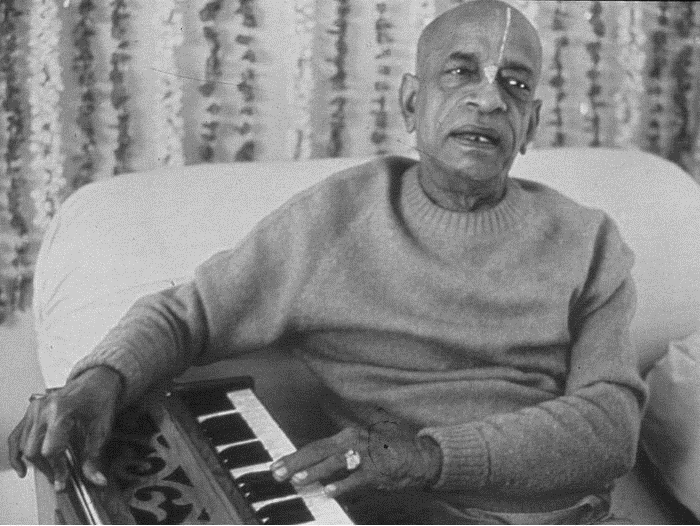
His Divine Grace
A. C. Bhaktivedanta Swami Prabhupāda
Founder-Ācārya of the International Society for Krishna Consciousness
nama oṁ viṣṇu-pādāya
kṛṣṇa-preṣṭhāya bhū-tale
śrīmate bhaktivedānta-
svāmin īti nāmine
namas te sārasvate deve
gaura-vāṇī-pracāriṇe
nirviśeṣa-śūnyavādi-
pāścātya-deśa-tāriṇe
śrī-kṛṣṇa-caitanya
prabhu nityānanda
śrī-advaita gadādhara
śrīvāsādi-gaura-bhakta-vṛnda
hare kṛṣṇa hare kṛṣṇa
kṛṣṇa kṛṣṇa hare hare
hare rāma hare rāma
rāma rāma hare hare