 Spiritual
Taking shelter of the Lord
The process of surrender
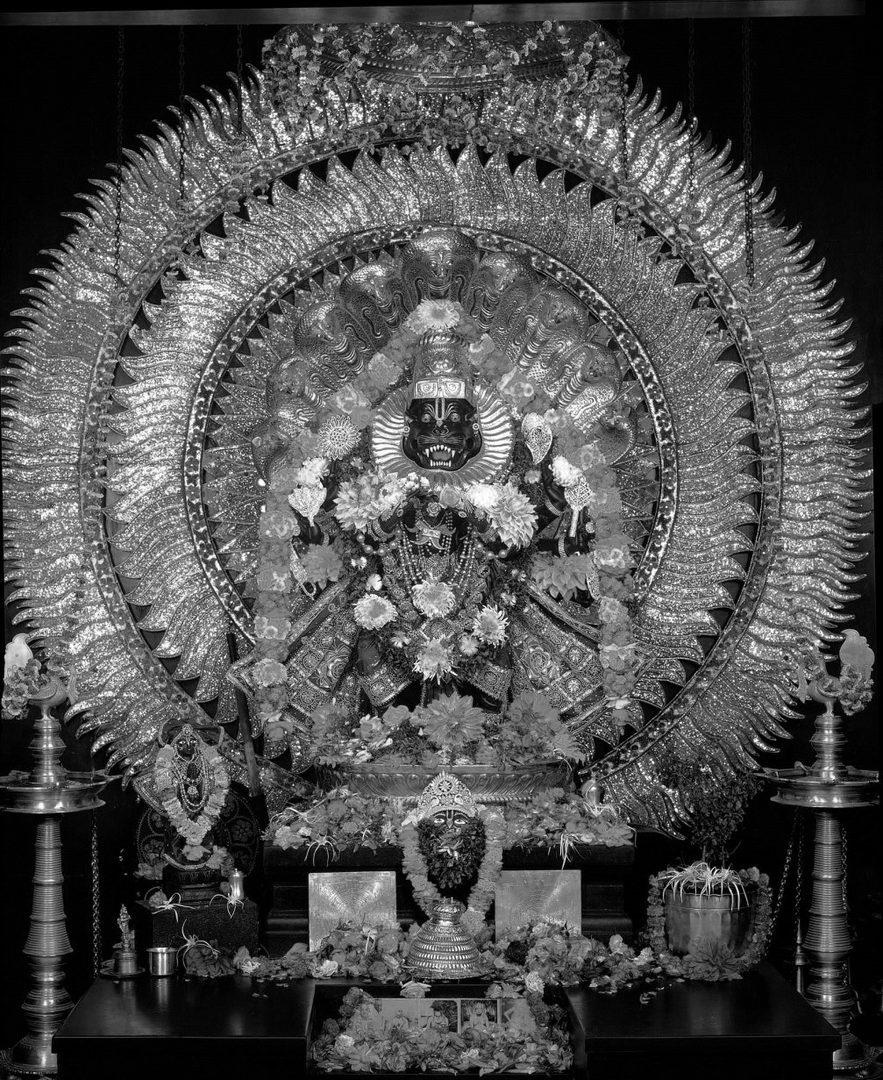
Śrī-kṛṣṇa-caitanya prabhu jīve dayā 263
Bhuliyā tomāre 265
Vidyāra vilāse 268
Āmāra jīvana 272
Emana durmati 276
Mānasa, deha, geha 279
Ātma-nivedana 284
Sarvasva tomāra caraṇe 286
Tumi sarveśvareśvara 289
Ekhana bujhinu prabhu! 292
Tuwā-bhakti-pratikūla 295
Śuddha-bhakata 298
Taking shelter of the Lord
The process of surrender
Bhaktivinoda Ṭhākura wrote en entire songbook called Śaraṇāgati which elaborates on the six processes of surrender to the Lord as explained by Śrī Caitanya Mahāprabhu to Sanātana Gosvāmī (Cc. Madhya-līlā, 20.100):
ānukūlyasya saṅkalpaḥ prātikūlyasya varjanam
rakṣiṣyatīti viśvāso goptṛtve varaṇaṁ tathā ātma-nikṣepa-kārpaṇye ṣaḍ-vidhā śaraṇāgatiḥ “The six divisions of surrender are the acceptance of those things favorable to devotional service, the rejection of unfavorable things, the conviction that Kṛṣṇa will give protection, the acceptance of the Lord as one’s guardian or master, full self- surrender, and humility.” Bhaktivinoda Ṭhākura reverses the order in his songbook by beginning with songs describing dainya, humility which seems to indicate that the process of surrender is not a stereotyped procedure but can be begun from any of the six divisions. In the Bhagavad-gītā, Kṛṣṇa describes the qualities of the demoniac nature in Chapter Sixteen. The first three are dambhaḥ (pride), darpaḥ (arrogance) and abhimānaḥ (conceit), which means that to overcome the tendency to vanity and cultivate humility is essential for the aspiring devotee. Unless one gives up false pride and realizes one’s insignificant position in the Lord’s creation, how can one surrender and act as a servant? The theme of the songs in Dainya is the same as in the songs of the second section of this songbook, Akṣepa: realization of one’s fallen condition and feeling remorseful. This attitude is conducive to develop humility and thus be able to sincerely take shelter of the Lord and His devotees. Bhaktivinoda Ṭhākura begins Śaraṇāgati with an introductory song.
Śrī-kṛṣṇa-caitanya prabhu jīve dayā kari'
1 śrī-kṛṣṇa-caitanya prabhu jīve dayā kari'
sva-pārṣada svīya dhāma saha avatari'
śrī-kṛṣṇa-caitanya prabhu—Śrī Kṛṣṇa Caitanya Prabhu; jīve—the conditioned souls; dayā-kari'—to show mercy; sva-pārṣada—His own associates; svīya—His own; dhāma—abode; saha—with; avatari'—descended.
Śrī Kṛṣṇa Caitanya Prabhu, along with His personal associates and divine abode, descended to this material world out of compassion for the fallen souls.
2 atyanta durlabha prema karibāre dāna
śikṣāya śaraṇāgati bhakatera prāna
atyanta—extremely; durlabha—difficult to obtain; prema—love for God; karibāre- dāna—in order to bestow; śikṣāya—teaches; śaraṇāgati—surrender; bhakatera— of the devotees ; prāna—the life.
In order to freely distribute the gift of ecstatic love of God, which is very difficult to obtain, He taught the path of śaraṇāgati, devotional surrender to the Supreme Lord which is the very life of the true devotees.
3 dainya, ātma-nivedana, goptṛtve varaṇa
'avaśya rakṣībe kṛṣṇa'-viśvāsa, pālana
dainya—humility; ātma-nivedana—full surrender; goptṛtve—as one´s maintaner; varaṇa—acceptance; 'avaśya—certainly; rakṣībe—He will protect; kṛṣṇa'—Śrī Kṛṣṇa; viśvāsa—faith; pālana—and protection.
The six ways of surrender through śaraṇāgati are (1) humility, (2) full surrender of the self, (3) acceptance of the Lord as one's only maintainer, (4) the consciousness of 'Kṛṣṇa will surely protect me' which is faith in Kṛṣṇa's protection.
4 bhakti-anukūla-mātra kāryera svīkara bhakti-pratikūla-bhāva varjanāṅgikāra bhakti—devotion; anukūla—of what is favorable; mātra—objects of sense enjoyment; kāryera—of acts; svīkara—acceptance; bhakti-pratikūla—unfavorable for devotion; bhāva—emotion; varjanāṅgikāra—rejection.
(5) execution of only those acts favorable to pure devotion, and (6) abstention of acts adverse to pure devotion.
5 ṣaḍ-aṅga śaraṇāgati hoibe jāṅhāra tāhāra prārthanā śune śrī-nanda-kumāra ṣaḍ-aṅga—the six limbs; śaraṇāgati—surrender; hoibe—will embody; jāṅ-hāra— one who; tāhāra—their; prārthanā—prayers; śune—hears; śrī-nanda-kumāra— Śrī Nanda-Kumāra.
Śrī Nanda-Kumāra, the youthful son of Nanda Mahārāja, hears the prayers of anyone who takes refuge in Him by this six-fold practice of surrender.
6 rūpa-sanātana-pade dante tṛṇa kari' bhakativinoda pare duhū pada dhori'
rūpa-sanātana-pade—at the feet of Śrī Rūpa and Śrī Sanātana; dante—in the teeth; tṛṇa-kori'—taking a straw; bhakativinoda—Bhakativinoda; pare—falls down; duhuṅ—both; pada—of the feet; dhori'—clasping.
Bhaktivinoda prostrates himself at the feet of Śrī Rūpa and Śrī Sanātana Goswāmī, places a straw between his teeth, and clasps their lotus feet with his hands.
7 kāṅdiyā kāṅdiyā bale āmi to' adhama
śikṣāye śaraṇāgati kara he uttama
kāṅdiyā kāṅdiyā—weeping; bale—he says; āmi—me; to´ adhama—the most fallen; śikṣāye-śaraṇāgati—teaching me surrender; kara—make; he—oh; uttama—transcendental, excellent.
Weeping and weeping, he tells them, “I am certainly the lowest of men! Please make me the worthiest by teaching me the ways of surrender!”

Commentary
In this song, Bhaktivinoda Ṭhākura outlines the process of surrender and begs Śrī Caitanya Mahāprabhu’s most intimate disciples, Rūpa Gosvāmī and Sanātana Gosvāmī, to be merciful and teach him how to offer everything, including the self, for the service of the Lord. Unless we receive the mercy of higher authorities in the form of knowledge and spiritual strength, it is difficult to even begin the process of surrender, what to speak of being successful. In the songs contained in this section of the songbook, Bhaktivinoda Ṭhākura shows by his own example what kind of mentality a devotee should cultivate in order to become eligible to receive the mercy of the Lord and
His devotees and thus attain the ultimate goal of the surrendering process, pure love of God.
Bhuliyā tomāre
1 bhuliyā tomāre, saṁsāre āsiyā,
peye nānā-vidha byathā tomāra caraṇe, āsiyāchi āmi, baliba duḥkhera kathā bhuliyā—forgetting; tomāre—You; saṁsāre—to this material world; āsiyā—having come; peye—experienced; nānā—many; vidha—varieties; byathā—of sufferings; tomāra—Your; caraṇe—to lotus feet; āsiyāchi—have come; āmi—I; baliba—I will speak; duḥkhera—of woe; kathā—my tale.
O Lord, having forgotten You and come to this material world, I have experienced a host of sins and sorrows. Now I approach Your lotus feet and submit my tale of woe.
2 jananī jaṭhare, chilāma yakhana,
viṣama bandhana-pāśe eka-bāra prabhu! dekhā diyā more, vañcile e dīna dāse jananī—of my mother; jaṭhare—in the womb; chilāma—I was; yakhana—when; viṣama—painful; bandhana—in the encagement; pāśe—bound up; eka—one; bāra—time; prabhu—O Lord; dekhā—a vision (of Yourself); diyā—having given; more—to me; vañcile—abandoned; e—this; dīna—poor; dāse—servant.
While I was bound up tightly in the unbearable confines of my mother’s womb, O Lord, You once revealed Yourself before me. After appearing briefly, You abandoned this poor servant of Yours.
3 takhana bhāvinu, janama pāiyā,
kariba bhajana tava janama hoila, pari' māyā-jāle, nā hoila jñāna-lava takhana—at that time; bhāvinu—I thought; janama—birth; pāiyā—after taking; kariba—I will perform; bhajana—worship; tava—Your; janama—birth; hoila— having taken; pari’—I fell; māyā—of illusions; jāle—into a network; nā—not; hoila— there was; jñāna—of knowledge; lava—a drop.
At that moment I thought, “After my birth this time, I will surely worship You with undivided attention.” But alas, after taking birth I fell into the entangling network of worldly illusions; thus I possessed not even a drop of true knowledge.
4 ādarera chele, sva-janera kole,
hāsiyā kāṭānu kāla janaka jananī-snehete bhuliyā,
saṁsāra lāgila bhāla
ādarera—dear; chele—son; sva-janera—of relatives; kole—in the arms; hāsiyā— laughing; kāṭānu—spent; kāla—my time; janaka—of my father; jananī—of my mother; snehete—by the affection; bhuliyā—I forgot (You); saṁsāra—the material world; lāgila—seemed to be; bhāla—good.
As a dear son fondled in the laps of attentive relatives, I passed my time smiling and laughing. The affection of my father and mother helped me forget You still more, and I began to think that the material world was a very nice place.
5 krame dina dina, bālaka hoiyā,
bhelinu bālaka-saha āra kichu dine, jnāna upajila, pāṭha pari ahara-ahaḥ krame—gradually; dina dina—day by day; bālaka—a young boy; hoiyā—I became; bhelinu—played; bālaka—other boys; saha—with; āra—more; kichu—(after) a few; dine—days; jnāna—my knowledge; upajila—grew; pāṭha—school lessons; pari—I studied; ahara-ahaḥ—every day.
Day by day I gradually grew into a young boy and began playing with other boys. Soon my powers of understanding emerged, so I diligently studied my school lessons every day.
6 vidyāra gaurave, bhrami' deśe deśe,
dhana uparjana kari sva-jana pālana, kari eka-mane, bhulinu tomāre, hari!
vidyāra—of my education; gaurave—proud; bhrami’—I traveled; deśe deśe—from place to place; dhana—of wealth; uparjana—the earning; kari—I did; sva-jana— of my family; pālana—the maintenance; kari—I did; eka—with one-pointed; mane—attention; bhulinu—I forgot; tomāre—You; hari—O Lord Hari.
Proud of my accomplished education, I later traveled from place to place and earned much wealth. Thereby maintaining my family with undivided attention, I forgot You, O Lord Hari!
7 bārdhakye ekhana, bhakativinoda,
kāṅdiyā kātara ati nā bhajiyā tore, dina bṛthā gela, ekhana ki habe gati?
bārdhakye—in old age; ekhana—now; bhakativinoda— Bhaktivinoda; kāṅdiyā— weeps; kātara—in sadness; ati—great; nā—not; bhajiyā—worshiped; tore—You; dina—days; bṛthā—useless; gela—have gone; ekhana—now; ki—what; habe— will be; gati—my fate.
Now in old age, this Bhaktivinoda very sadly weeps as death approaches. I failed to worship You, O Lord, and instead passed my days in vain. What will be my fate now?
Commentary
This song is the first one in Bhaktivinoda Ṭhākura’s songbook Śaranāgati, First Principle of Surrender: Dainya (Humility). There are a few lectures, Prabhupāda quotes from this song. Lecture on Śrīmad-Bhāgavatam 5.5.7 – Vṛndāvana, October 29, 1976 What is our position? Our position is as described by Caitanya Mahāprabhu, jīvera svarūpa haya nitya-kṛṣṇa-dāsa [Cc. Madhya 20.108-109]. Our real position is that I am eternal servant of Kṛṣṇa. So gata-smṛtiḥ, I have forgotten that. And therefore, bhuliyā tomāre saṁsāre āsiyā peye nānā-vidha byathā. Bhaktivinoda Ṭhākura's song, "My Lord, forgetting You I came in this material world. I am simply suffering." Peye nānā-vidha byathā. The same thing is there in the Vedic literature, the same thing is instructed by the advanced, enlightened, liberated devotee. The same thing. This forgetfulness. We have forgotten what is our position. Temporarily, because I have got this body in India, I am thinking, "I am Indian, so my interest is Indian." And somebody is thinking, "My interest is American," "My interest is brāhmaṇa," "My interest is śūdra," "My interest is this, that." We have created so many interests. That has to be rectified. Lecture on Śrīmad-Bhāgavatam 2.3.24 – Los Angeles, June 22, 1974 Bhaktivinoda Ṭhākura sings that "My dear Lord, when I was in the womb of my mother, at that time I saw You once, You became visible." Those who are spiritually advanced, they can see God within the womb of the mother. When a child remains packed up and the consciousness is gained, he feels very uncomfortable. So at that time, one who is pious, spiritually advanced, he prays to God, "Please rescue me from this bondage. I am too much suffering. And this time, after taking my birth, I shall simply be engaged in Kṛṣṇa consciousness." He promises. But Bhaktivinoda Ṭhākura says, janama hoila paṛi' māyā-jāle. As soon as birth is taken, the māyā is there; we forget. Immediately, father, mother, other relatives, they take up the child and pats very nice. So in this way we forget that we were in such a precarious condition, almost suffocating. Almost, it is suffocating. After coming out from the womb of the mother, if you are packed up again in such airtight bag, within three seconds you will die. We live under the protection of the Supreme Lord; otherwise that is not a living condition. Just imagine within the womb. So this we forget, and being taken care of, affectionate father and mother, on the lap, we think life is very nice, this life. But this is māyā, this is illusion. Actually, this bhava, to take birth, is very, very unpleasant task. It is blazing fire, bhava-mahā-dāvāgni.
Vidyāra vilāse Bhaktivinoda Ṭhākura
1 vidyāra vilāse, kāṭāinu kāla,
parama sāhase āmi tomāra caraṇa, nā bhajinu kabhu, ekhana śaraṇa tumi vidyāra vilāse—in the distractions of mundane learning; kāṭāinu kāla—I passed the time; parama sahase—with great confidence; āmi—I; tomāra caraṇa—Your lotus feet, O Lord; nā bhajinu—I did not worship; kabhu—ever; ekhana—but now; śaraṇa tumi—You are my only shelter.
With great enthusiasm I spent my time in the pleasures of mundane learning, and never worshiped Your lotus feet, O Lord. Now You are my only shelter.
2 parite parite, bharasā bārila,
jñāne gati habe māni' se āśā biphala, se jñāna durbala, se jñāna ajñāna jāni parite parite—reading on and on; bharasā bārila—my hope grew; jñāne—material knowledge; gati—life's true goal; habe—will be attained; māni'—I considered; se āśā—that hope; biphala—was fruitless; se jñāna—that knowledge; durbala— proved feeble; se jñāna—that knowledge; ajñāna—ignorance; jāni—I understand.
Reading on and on, my hopes grew and grew, for I considered the acquisition of material knowledge to be life's true goal. How fruitless those hopes turned out to be, for all my knowledge proved feeble. Now I understand that all such erudition is actually pure ignorance.
3 jaḍa-vidyā yata, māyāra vaibhava,
tomāra bhajane bādhā moha janamiyā, anitya saṁsāre, jīvake karaye gādhā jaḍa-vidyā—mundane knowledge; yata—all; māyāra vaibhava—is the power of the illusory energy; tomāra bhajane—to Your service; bādhā—an impediment; moha janamiyā—bringing about infatuation; anitya saṁsāre—for this temporary world; jīvake—to the eternal soul; karaye gādhā—it turns into an ass.
All the so-called knowledge of this world is born of the flickering potency of Your illusory energy (māyā). It is an impediment to the execution of devotional service to You. Indulgence in mundane knowledge verily makes an ass of the eternal soul by encouraging his infatuation with this temporary world.
4 sei gādhā ha’ ye, saṁsārera bojhā,
vahinu aneka kāla bārdhakye ekhana, śaktira abhāve, kichu nāhi lāge bhāla sei gādhā ha' ye—here is one such ass; saṁsārera bojhā—the burden of material existence; vahinu—I have carried on my back; aneka kāla—for a long time; bārdhakye—in my old age; ekhano—now; śaktira abhāve—for want of the power to enjoy; kichu nāhi—absolutely nothing; lāge bhāla—pleases me.
Here is one person who has been turned into such an ass, who for so long has carried on his back the useless burden of material existence. Now in my old age, for want of the power to enjoy, I find that nothing at all pleases me.
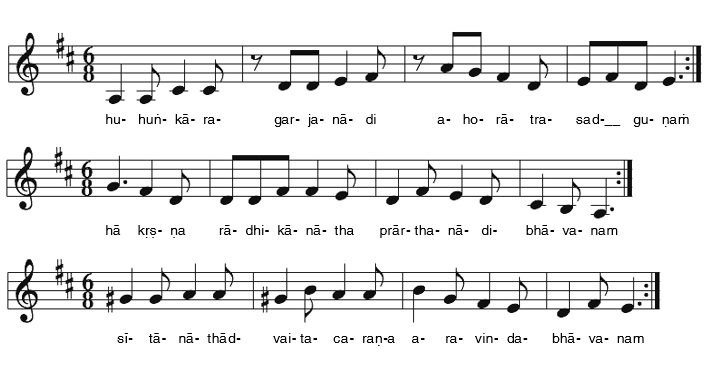
5 jīvana jātanā, hoila ekhana,
se vidyā avidyā bhela avidyāra jvālā, ghaṭila viṣama, se vidyā hoila śela jīvana—life; jātanā—agony; hoilo—has become; ekhano—now; se vidyā—that knowledge; avidyā bhelo—has become ignorance; avidyāra jvālā—the burning pain of ignorance; ghaṭilo viṣama—has become intolerable; se vidyā—that knowledge; hoila śela—has become a pointed spear.
Life has now become agony, for my so-called erudite knowledge has proven itself to be worthless ignorance. Material knowledge has now become a pointed shaft and has pierced my heart with the intolerable, burning pain of ignorance.
6 tomāra caraṇa, vinā kichu dhana,
saṁsāre nā āche āra bhakativinoda, jaḍa-vidyā chāri,'
tuvā pada kare sāra
tomāra caraṇa—Your lotus feet; vinā—besides; kichu dhana—any treasure; saṁsāre—in this world; nā āche āra—there is none else; bhakativinoda— Bhaktivinoda; jaḍa-vidyā chāri'—giving up all mundane knowledge; tuvā pada— Your lotus feet; kare sāra—makes the sum and substance of his life.
O Lord, there is no treasure worth seeking in this world other than Your lotus feet. Bhaktivinoda abandons all his mundane knowledge and makes Your lotus feet the sum and substance of his life.
Commentary
This is the second song in Bhaktivinoda Ṭhākura’s songbook Śaranāgati, First Principle of Surrender: Dainya (Humility). We have no recording of Prabhupāda singing this song, but he quotes from Vidyara-vilase more than 30 times in his lectures and conversations denouncing the uselessness of mundane education. Here are some examples: Śrīmad-Bhāgavatam 4.29.47 – Purport Generally people are very much attracted to the fruitive activities sanctioned in the Vedic rituals. One may be very much attracted to becoming elevated to heavenly planets by performing great sacrifices, like those of King Barhiṣmān. Śrī Nārada Muni wanted to stop King Barhiṣmān from engaging in such fruitive activities. Therefore he is now directly telling him, "Don't be interested in such temporary benefits." In modern civilization people are very much interested in exploiting the resources of material nature through the methods of science. Indeed, this is considered advancement. This is not actually advancement, however, but is simply pleasing to hear. Although we are advancing according to such concocted methods, we are forgetting our real purpose. Bhaktivinoda Ṭhākura therefore says, jaḍa-vidyā yata māyāra vaibhava tomāra bhajane bādhā: "Materialistic studies are the glare of māyā only, for they are an obstacle to spiritual progress." The temporary comforts of life experienced either on this planet or on other planets are all to be taken as illusory because they do not touch the real purpose of life. The real purpose of life is to go back home, back to Godhead. Ignorant of the real purpose of life, people take to either gross materialistic activities or ritualistic
activities. King Barhiṣmān is herein requested not to be attached to such activities. In the Vedas it is stated that the performance of sacrifice is the actual purpose of life. Lecture on Bhagavad-gītā 2.40-45 – Los Angeles, December 13, 1968 So we do not know that we are standing on a tottering platform. However nice arrangement we may make, this will be finished in one moment. That we are missing. We are simply sticking to a false platform that "This will save me, this will save me." No. Therefore Bhaktivinoda Ṭhākura says that jaḍa-vidyā yata māyāra vaibhava. This material advancement of civilization, very nice, very dazzling. Just like when we pass on the street or road of your American cities, it looks so nice. So many lights and so many night-illuminating signboards. But we should always remember that this nice situation is not permanent settlement. Any moment I'll have to give up everything. Everything. So therefore, if one becomes attached to this false platform, illuminating, so-called illuminating, false platform, then his determination to go back to Godhead will not be very much intense. That is being explained. So bhogaiśvarya-prasaktānām. "In the minds of those who are too attached to sense enjoyment and who are bewildered by such things, the resolute determination for devotional service to the Lord does not take place." Lecture on Nectar of Devotion – Calcutta, January 25, 1973 The so-called material advancement has curbed down the dormant propensities for loving God, or Kṛṣṇa. Therefore Bhaktivinoda Ṭhākura says that jaḍa-vidyā saba māyāra vaibhava. Jaḍa-vidyā saba māyāra vaibhava, tomāra bhajane bādhā. The more artificially we make advancement of material civilization, the more we become away from devotional service. Practically we can see. People are engaged in developing their material resources. Everyone is busy. And we, if our men approach, then they think it is simply waste of time. "All right. They're asking something. Give them some money. Let them go away, and let my business be done nicely." So this is the propensities observed by Bhaktivinoda Ṭhākura: jaḍa- vidyā saba māyāra vaibhava. The more we advance in material civilization, we become backward in Kṛṣṇa consciousness. Our principle is, therefore, to minimize the artificial necessities of life, as much as possible. Nirbandhe kṛṣṇa-sambandhe. Anāsaktasya viṣayān. We should eat, sleep, not for material comfort. But eating is required. Without eating, we cannot live. Sleeping is required, to give rest for some time. For that purpose, we shall eat, sleep... Nirbandha kṛṣṇa-sambandhe. Anāsaktasya viṣayān. We should not be attached. That will make our spiritual progress firm.
Lecture on Śrī Īśopaniṣad, Mantra 9 – Los Angeles, May 13, 1970 So leaders should think over it, that "What we are producing, in spite of so many educational institutions?" That is hinted here, that because you are worshiping avidyā... That is not knowledge. Bhaktivinoda Ṭhākura has sung very nicely: jaḍa- vidyā saba māyāra vaibhava. Jaḍa-vidyā. Jaḍa-vidyā means this material education. He says they are expansion of this māyā. Jaḍa vidyā. Jaḍa vidyā sa māyāra vaibhava, tomāra bhajane bādhā. The more we shall advance in this material education, the more we will be hampered to understand what is God. And at last we shall declare, "God is dead. I am God. You are God," all this nonsense. That is hinted here: andhaṁ tamaḥ. Andham means darkness. There are two kinds of darkness. If you remain in ignorance, that is also darkness, and if you remain actually in darkness, where there is no sunlight, there is no electric light, that is also darkness. So avidyām upāsate. Another, tato bhūya iva te tamo ya u vidyāyāṁ ratāḥ. So these materialists, they are certainly being pushed in the darkness, but there is another class, who are so-called philosopher, mental speculators, religionists, yogis. They are going still more in the darkness, because they are defying Kṛṣṇa. They are posed as if culturing spiritual knowledge, but because they have no information of Kṛṣṇa, or God, their advancement of education is also more dangerous. More dangerous. Because they are misleading people. Morning Walk – April 20, 1973, Los Angeles Bhaktivinoda Ṭhākura says: jaḍa-vidyā yata māyāra vaibhava tomāra bhajane bādhā, anitya saṁsāre moha janamiyā jībake karaye gādhā. This jaḍa-vidyā, this material science, is simply a hindrance to our progress of spiritual life. All these rascal scientists, they'll deny God. That is their business. Just like you said yesterday that somebody was accepting God, and the other scientists, they thought: "No, it is insult." So already they are in oblivion. They cannot understand what is God. And these rascals are making them more and more rascals. "There is no God." By their scientific research, the rascals are becoming more rascals. And they're becoming captivated: "This is pleasure." What pleasure you will do you with. Therefore they are, they are gādhā (ass). They are gādhā and they are creating gādhās. That is the song of Bhaktivinoda Ṭhākura. Jaḍa-vidyā yato māyāra... It is expansion of māyā's illusory energy. So they're forgetting their real purpose of life The so-called scientific advancement is simply expanding the influence of māyā's illusory energy. They're already rascals and fools, and still they are being made rascals and fools. and the whole human life is spoiled. This is the result of so-called scientific advancement.
Āmāra jīvana Bhaktivinoda Ṭhākura
1 āmāra jīvana, sadā pāpe rata,
nāhika puṇyera leṣa parere udvega, diyāchi ye kata, diyāchi jīvere kleśa āmāra—my; jīvana—life; sadā—always; pāpe—in sinful activities; rata—engaged; nāhika—there is not; puṇyera—of pious activities; leṣa—a trace; parere—to others; udvega—anxiety; diyāchi—I am inclined to give; ye—who; kata—great; diyāchi—I give; jīvere—to living entities; kleśa—suffering.
My life is always engaged in sinful activities, without a trace of pious activities. I am always inclined to give great anxiety and trouble to other living entities.
2 nija sukha lāgi', pāpe nāhi ḍari,
dayā-hīna svārtha-para para-sukhe duḥkhī, sadā mithya-bhāṣī, para-duḥkha sukha-kara nija—my own; sukha—happiness, pleasure; lāgi’—for; pāpe—in sinful activity; nāhi—there is no; ḍari—restraint; dayā—mercy; hīna—devoid of; sva-artha—to my personal interest; para—I am dedicated; para—of others; sukhe—in the happiness; duḥkhī—I am unhappy; sadā—always; mithya—false; bhāṣī—words; para—of others; duḥkha—the misery; sukha—my happiness; kara—makes.
For my personal pleasure, I don’t hesitate to commit any kind of sinful activity. I am not at all merciful, and I see only to my personal interest. When others are suffering I become very happy, I am always speaking lies, and if someone is suffering, that is very pleasant to me.
3 āśeṣa kāmanā, hṛdi mājhe mora,
krodhī, dambha-parāyaṇa mada-matta sadā, viṣaye mohita, hiṁsā-garva vibhūṣaṇa āśeṣa—endless; kāmanā—material desires; hṛdi—the heart; mājhe—in; mora— my; krodhī—I am angry; dambha—to deceit; parāyaṇa—dedicated; mada—mad; matta—with intoxication; sadā—always; viṣaye—in sense gratification; mohita— captivated; hiṁsā—malice; garva—false pride; vibhūṣaṇa—ornaments.
I have lots of material desires within my heart and am always angry and deceitful. I am captivated by subject matters of sense gratification and am almost crazy. My ornaments are malice and false pride.
4 nidrālasya hata, sukārye virata,
akārye udyogī āmi pratiṣṭha lāgiyā, śāṭhya-ācaraṇa, lobha-hata sadā kāmī nidra—by sleep; ālasya—by laziness; hata—attacked; sukārye—to pious activities; virata—averse; akārye—of impious activities; udyogī—a performer; āmi—I am; pratiṣṭha—prestige; lāgiyā—for the sake of; śāṭhya—cheating; ācaraṇa—behavior; lobha—by greed; hata—conqured; sadā—always; kāmī—a lusty person.
I am conquered by sleep and laziness and am always averse to pious activities, but I am very enthusiastic to perform impious activities. I always cheat others for my prestige, I am conquered by greed, and I am always lusty.
5 e hena durjana, saj-jana-varjita,
aparādhi nirantara śubha-kārya-śūnya, sadānartha-manāḥ, nānā duḥkhe jara jara e—a; hena—such; durjana—fallen person; saj-jana—with devotees of the Lord; varjita—devoid of association; aparādhi—an offender; nirantara—always; śubha— auspicious; kārya—activity; śūnya—devoid; sadā—always; anartha— mischievous; manāḥ—mind; nānā—all kinds of; duḥkhe—sufferings; jara jara— very old age.
I am so fallen, I have no association with devotees, and I am always an offender. In my life there is not a bit of auspicious activity, and my mind is always attracted by something mischievous. Therefore, at the fag end of my life I have become almost an invalid because of all such sufferings.
6 bārdhakye ekhana, upāya-vihīna,
tā' te dīna akiñcana bhakativinoda, prabhura caraṇe, kare duḥkha nivedana bārdhakye—in old age; ekhana—now; upāya—an alternative means; vihīna— without; tā’ te—therefore; dīna—humble; akiñcana—poor; bhakativinoda— Bhaktivinoda; prabhura—of the Lord; caraṇe—to the lotus feet; kare—makes; duḥkha—with sadness; nivedana—offering.
Now in my old age, with no alternative, I have by force become very humble and meek. Thus Bhaktivinoda offers this sad statement of his life’s activities at the lotus feet of the Supreme Lord.
Commentary
This is the fourth song in Bhaktivinoda Ṭhākura’s songbook Śaranāgati, First Principle of Surrender: Dainya (Humility). Here the author puts himself in the position of a conditioned soul and expresses remorse over his selfish life-style and
approaches the Lord in a mood of surrender. To become introspective and understand one’s fallen condition is undoubtedly helpful for advancement on the path of self-realization. Unless we understand the nature of our false self and become determined to purify our existence and discover our real self, there is no question of advancing in spiritual life. Purport to Āmāra jīvana Amāra jīvana sadā pāpe rata nāhiko puṇyera leśa. This is a song sung by Bhaktivinoda Ṭhākura in Vaiṣṇava humbleness. A Vaiṣṇava is always meek and humble. So he is describing the life of the people in general, taking himself to be one of them. The people in general are like the description given here. He says that "My life is always engaged in sinful activities, and if you try to find out, you will not find even a trace of pious activities. Only full of sinful activities. And I am always inclined to give trouble to other living entities. That is my business. I want to see that others are suffering, and I enjoy.'' Nija sukha lāgi' pāpe nāhi ḍori. "For my personal sense gratification, I do not care for any sinful activities. That means I accept any kind of sinful activity if it is satisfactory to my senses.'' Dayā-hīna swārtha-paro. "I am not at all merciful, and only I see to my personal interest.'' Para- sukhe duḥkhī. "As such, when others are suffering I become very happy, and always talking lies,'' sadā mithyā-bhāṣī. "Even for ordinary things I am accustomed to speak lies.'' Para-duḥkha sukha-karo. "And if one is suffering, that is very pleasant to me.'' Aśeṣa kāmanā hṛdi mājhe mora. "I have got lots of desire within my heart, and I am always angry and falsely prestigious, always puffed up with false pride.'' Mada-matta sadā viṣaye mohita. "I am captivated in subject matters of sense gratification, and almost I am crazy.'' Hiṁsā-garva vibhūṣaṇa. "My ornaments are enviousness and false pride.'' Nidralāsya hata sukārje birata. "I am subdued, or I am conquered by sleep and laziness,'' sukārje birata, "and I am always averse to pious activities,'' akārje udyogī āmi, "and I am very enthusiastic to perform impious activities.'' Pratiṣṭha lāgiyā śāṭhya-ācaraṇa, "I always cheat others for my prestige.'' Lobha-hata sadā kāmī, "I am conquered by greediness and always lusty.'' E heno durjana saj-jana-barjita, "So I am so fallen, and I have no association of devotees.'' Aparadhi, "Offender,'' nirantara, "always.'' Śubha-kārja-śūnya, "In my life, there is not a beat of auspicious activities,'' sadānartha manāḥ, "and my mind is always attracted by something mischievous.'' Nānā duḥkhe jara jara. "Therefore at the fag end of my life, I am almost invalid by all such sufferings.'' Bārdhakye ekhona upāya-vihīna, "In my old age I have no other alternative now,'' tā 'te dīna akiñcana, "therefore by force, I have now become very humble and meek.'' Bhaktivinoda prabhura caraṇe, "Thus Bhaktivinoda Ṭhākura is offering his statement of life's activities at the lotus feet of the Supreme Lord." Lecture on Nectar of Devotion – Vṛndāvana, October 23, 1972 A mahā-bhāgavata feels that "I am the lowest." Just like Bhaktivinoda Ṭhākura has sung, āmāra jīvana sada pāpe rata nāhika puṇyera leśa. He says that "My life is always engaged in sinful activities. I've not a trace of pious activity." Āmāra jīvana sada ape rata nāhika puṇyera leśa. "I have given so much distress to all other living entities." He's representing common man. But he's feeling like that. It is not that artificially speaking. He's feeling like that. Just like Rādhārāṇī. She thinks always Herself as the lowest of the devotees. She thinks always. She sees always that the gopīs, other gopīs, they are better qualified to serve Kṛṣṇa. And She is not qualified, so much qualified. Therefore in Vṛndāvana, you'll find, the devotees approach Rādhārāṇī. "Jaya Rādhe." Because if Rādhārāṇī advocates for him to Kṛṣṇa, it is very easily accepted. And Rādhārāṇī says... If Rādhārāṇī's pleased, then She represents the devotee's case that "Here is a devotee. He's better than Me. Kindly accept his service, Kṛṣṇa." So Kṛṣṇa cannot deny. So mahā-bhāva. Rādhārāṇī is mahā-bhāva.
Emana durmati
1 (prabhu he!) emana durmati, saṁsāra bhitare,
pariyā āchinu āmi tava nija-jana, kana mahājane,
pāṭhāiyā dile tumi
emana—such; durmati—bad disposition, evil mind; saṁsāra—the cycle of birth and death; bhitare—within; pariyā—falling down (I fell down); āchinu āmi—I am staying; tava—Your; nija-jana—own people; kona—one rare; mahājane—great personality; pāṭhāiyā—sent; dile tumi—You delivered.
O Lord! With such a wicked mind as this I have fallen into the material world, but You have sent one of Your pure and elevated devotees to rescue me.
2 dayā kari' more, patita dekhiyā,
kahila āmāre giyā ohe dīna-jana, śuna bhāla kathā, ullasita ha'be hiyā dayā-kari'—having been compassionate; more—to me; patita—fallen; dekhiyā— seeing; kahila—he said; āmāre—Me; giyā—going; ohe-dīna-jana—o humble soul; śuno—listen; bhālo—good; kathā—speak;ullasita—jubilant; ha'be—there will be; hiyā—heart.
He saw me so fallen and wretched, took pity, and came to me saying, "O humbled soul, please listen to this good tiding, for it will gladden your heart.
3 tomāre tārite, śrī-kṛṣṇa-caitanya,
navadvīpe avatāra tomā hena kata, dīna hīna jane,
karilena bhava-pāra
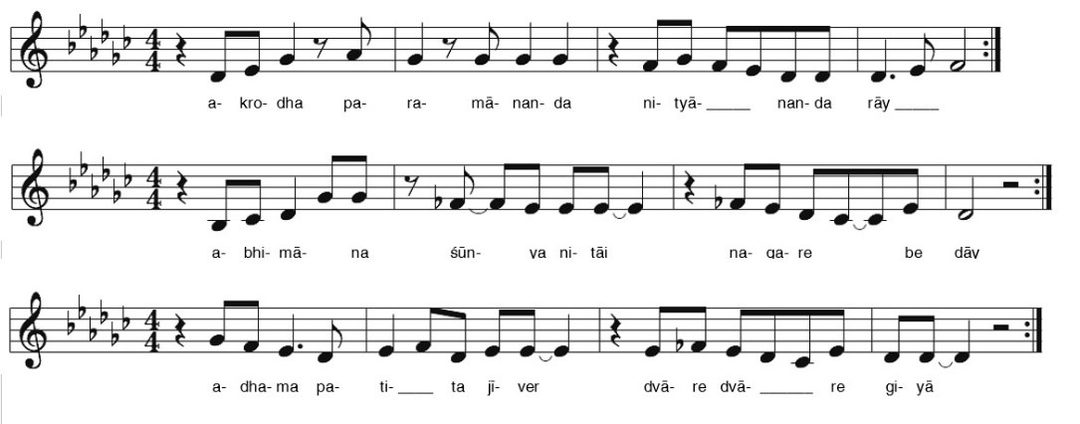
tomāre—you; tārite—to deliver; śrī-kṛṣṇa-caitanya—Śrī Kṛṣṇa Caitanya; navadvīpe—Navadvīpa; avatāra—descended; tomā—you; hena—such as/thus; kata—many; dīna—poor; hīna—low/inferior; jane—to the living beings; karilena— he made;made up/did; bhava-material existence; pāra—croos over.
Śrī Kṛṣṇa Caitanya has appeared in the land of Navadvīpa in order to deliver you. He has safely conducted many miserable souls such as you across the sea of worldly existence.
4 vedera pratijñā, rākhibāra tare,
rukma-varna vipra-suta mahāprabhu nāme, nadīyā mātāya, saṅge bhāi avadhūta vedera—of the Vedas; pratijñā—promise; rākhibāra—to keep; tare—him; rukma—golden; varna—color; vipra—brāhmaṇa; suta—son; mahāprabhu— Mahāprabhu; nāme—by the name; nadīyā—Nadīyā; mātāya—maddens; saṅge— in association; bhāi—brother; avadhūta—Nityānanda Prabhu who is beyond mundane, social convention.
To fulfill the promise of the Vedas, the son of a brāhmana, of golden complexion and bearing the name of Mahāprabhu, has descended along with His brother, the avadhūta. Together They have overwhelmed all of Nadīyā with divine ecstasy.
5 nanda-suta jini, caitanya gosāi,
nija-nāma kari' dāna tārila jagat, tumi-o yāiyā, laha nija-paritrāna nanda-suta—the son of Nanda Mahārāja; jini—who; caitanya—Śrī Caitanya; gosāi—the great personality; nija—his own; nāma—name; kari'-dāna—having distributed; tārila—delivered; jagat—of the universe; tumi-o—tu; yāiyā—having gone; laha—take; nija—His own, your; paritrāna—deliverance.
"Śrī Caitanya Gosāi, who is Kṛṣṇa Himself, the son of Nanda, has saved the world by freely distributing the gift of His own holy name. Go to Him also and receive your deliverance."
6 se kathā śuniyā, āsiyāchi, nātha!
tomāra caraṇa-tale bhakativinoda, kāṅdiyā kāṅdiyā, āpana-kāhinī bale se—that; kathā—talk; śuniyā—by hearing; āsiyāchi—have come; nātha!—O master; tomāra—Your; caraṇa-tale—under the shelter of the lotus feet; bhakativinoda—Bhakativinoda; kāṅdiyā—crying; kāṅdiyā—crying; āpana—his; kāhinī—story; bale—he tells.
Hearing those words, O Lord, Bhaktivinoda has come weeping and weeping to the soles of Your lotus feet and tells the story of his life.
Commentary
This is the last song in the section First Principle of Surrender: Dainya (Humility) of Bhaktivinoda Ṭhākura’s songbook Śaraṇāgati. It differs from the first six where the ācārya is lamenting his fallen condition. In this song he opens a window of hope by telling us about the advent of Lord Caitanya, the savior of the fallen souls. Thus Bhaktivinoda Ṭhākura introduces the Second Principle of Surrender: Atma- nivedana (Full dedication of the self). In Emana durmati he still mentions his disqualifications but has come to the point of offering everything in his possession to the Lord, culminating in the eighth and last song (Ātma-nivedana) where the Ṭhākura describes the wonderful results of surrender. The dark clouds of despair have dissipated and the heart is flooded by the bright sunlight of spiritual bliss: “I have become supremely happy by surrendering myself at Your lotus feet. Sorrow has gone far away, and there are no more cares. All I see is joy in the four directions.” The next section, Second Principle of Surrender: Ātma-nivedana, begins with a well-known song, Mānasa, deha, geha.
Mānasa, deha, geha
1 mānasa, deha, geha, yo kichu mora
arpilūṅ tuwā pade, nanda-kiśora!
mānasa—my mind; deha—body; geha—family and home; yo kichu—whatever; mora—is mine; arpilū—I have offered; tuwā pade—at Your lotus feet; nanda- kiśora—O youthful son of Nanda!
Mind, body, and family, whatever may be mine, I have surrendered at Your lotus feet, O youthful son of Nanda!
2 sampade vipade, jīvane-maraṇe dāya mama gelā, tuwā o-pada varaṇe sampade vipade—in good fortune or in bad; jīvane-maraṇe—in life or death; dāy— difficulties; mama—my; gelā—have disappeared; tuwā o-pada—those feet of Yours; varaṇe—by submissive acceptance.
In good fortune or bad, in life or death, all my difficulties have disappeared because I have chosen those lotus feet of Yours as my only shelter.
3 mārabi rākhabi-yo icchā tohārā
nitya-dāsa prati tuwā adhikārā
mārabi rākhabi—slay me or protect me; yo icchā tohāra—as You wish; nitya- dāsa—Your eternal servant; prati—toward; tuwā adhikāra—it is Your prerogative.
Slay me or protect me as You wish, for You are the master of Your eternal servant.
4 janmāobi more icchā yadi tora bhakta-gṛhe jani janma hau mora janmāobi more—that I be born again; icchā yadi tora—if it is Your will; bhakta- gṛhe—in the home of Your devotee; jani janma—take birth; hau—may it be; mora— mine.
If it is Your will that I be born again, then may it be in the home of Your devotee.
5 kīṭa-janma hau yathā tuvā dāsa bahira-mukha brahma janme nāhi āśa kīṭa-janma—born as a worm; hau—may it be; yathā—so long as; tuvā dāsa—I remain Your devotee; bahira-mukha—averse to You; brahma-janme—to be born as Lord Brahmā; nāhi āśa—I have no desire.
Let me be born again even as a worm, as long as I may remain Your devotee. I have no desire to be born as a Brahmā averse to You.
6 bhukti-mukti-spṛhā vihīna ye bhakta
labhaite tāka saṅga anurakta
bhukti-mukti-spṛhā—desire for worldly enjoyment or liberation; vihīna—who is completely devoid; ye bhakta—that devotee; labhaite—to attain; tāka saṅga—their association; anurakta—I yearn.
I yearn for the company of that devotee who is completely free of all desire for worldly enjoyment or liberation.
7 janaka, jananī, dayita, tanaya prabhu, guru, pati-tuhū sarva-maya janaka—father; jananī—mother; dayita—lover; tanay—son; prabhu—Lord; guru— preceptor; pati—husband; tuh—You; sarva-moy—are everything to me.
Father, mother, lover, son, Lord, preceptor, husband—You are everything to me.
8 bhakativinoda kahe, śuna kāna! rādhā-nātha! tuhū hāmāra parāṇa bhakativinoda kahe—Ṭhākura Bhaktivinoda says; śuna kāna!—O Kāna, please hear me!; rādhā-nātha!—O Lord of Rādhā!; tuhū—You; hāmāra parāṇa—are my life and soul.
Bhaktivinoda says, "O Kāna, please hear me! O Lord of Rādhā, You are my life and soul!"
Commentary
This song is found in Bhaktivinoda Thākura’s songbook Śaraṇāgati, in the section Second Principle of Surrender: Ātma-Nivedana (Dedication of the Self). It is the third song of eight. Śrīla Prabhupāda quotes from this song frequently:
Lecture on Śrīmad-Bhāgavatam 1.8.24 – Los Angeles, April 16, 1973 Draupadī was also first of all trying to save her cloth. And what she can do? She is woman, and they were two men. Karṇa and Duḥśāsana was trying to make her naked. So she was crying and praying to Kṛṣṇa, "Save my honor." But she was trying also herself to save. When she thought that "It is impossible to save myself, my honor, in this way," then he (she) left the hands. She simply got up her arms and prayed, "Kṛṣṇa, if You like, You can save." So this is the position. So long we try to save ourself, then that is not very good. If you simply depend on Kṛṣṇa, "Kṛṣṇa, if You save me, that is all right. Otherwise kill me, as You like." You see? Mārabi rākhabi—yo icchā tohārā. Bhaktivinoda Ṭhākura says, "I surrender unto You." Mānasa, deha, geha, yo kichu mora, “My dear Lord, whatever I have got, my possession... And what I have got? I have got this body. I have got my mind. I have got a little home and my wife, my children. This is my possession.” So, mānasa, deha, geha, yo kichu mora. "So whatever I have got— this body, this mind, this wife, these children, this home, everything I surrender unto You." Mānasa, deha, geha, yo kichu mora, arpiluṅ tuvā pade, nanda-kiśora. Kṛṣṇa is known as Nanda-kiśora. So this is surrender, no reservation, full surrender, is called akiñcana. Lecture on Śrīmad-Bhāgavatam 1.7.15 – Vṛndāvana, September 13, 1976 This is Caitanya Mahāprabhu's teaching, that "From Kṛṣṇa's side, He may do whatever He likes"—that is full surrender—"still, He is my master." Bhaktivinoda Ṭhākura has sung, mānasa deha geha yo kichu mora arpilu tuvā pade nanda-kiśora. Nanda-kiśora is Kṛṣṇa. So this is full surrender. "My dear Nanda-kiśora, whatever I have got, now I am offering everything to You." What I have got? Mānasa deha geha: "I have got my body, I have got my mind, and a so-called home or a wife or a few children. What I have got? So everything is offered to You." Mānasa, deha, geha, yo kichu mora. This is full surrender. Now he says, mārabi rākhabi yo icchā tohārā: "I am surrendering to You everything. Now if You like You can save me, or if You like You can kill me." This is full surrender. Lecture on Śrīmad-Bhāgavatam 1.5.18 – New Vrindavan, June 22, 1969 So, Bhaktivinoda Ṭhākura is addressing, "My dear Nanda-kiśora, young boy of, young child, or young son of Nanda Mahārāja," mānasa deha geha, "my mind, my body, my family," mānasa deha geha yo kichu, "whatever I think 'This is mine...' " Because we are conditioned souls, "my," "I," and "mine," this is our disease. "So whatever I am thinking 'It is mine'... First of all, 'This body's mine,' or 'The home, the family, that is mine.' " So mānasa deha geha, yo kichu... "Whatever I have got in my possession, now I am surrendering unto You." Arpiluṅ tuvā pade nanda-kiśora. This is surrender. "So I am giving unto You my family, my home, my body, my mind, everything." Arpilū tuvā pade nanda... "Now, whatever You like, You do." That is very nice song. So we have to do that. Then Kṛṣṇa will take care. That's all. The same example: you simply have to capture the rope.Then you'll be lifted immediately. Lecture on Śrīmad-Bhāgavatam 7.9.12 – Mayapur, February 19, 1976, So Prahlāda Mahārāja decided, tasmād ahaṁ vigata-viklava īśvarasya sarvātmanā. Real thing is with heart and soul everything. No reservation. Just like Bhaktivinoda Ṭhākura, he surrenders to Kṛṣṇa everything, whatever he has got. He says, manasa deha geha, yo kichu mora: "Whatever I have got, no reservation." So what I have got in this material... He said, "I have got this body, material body, lump of matter, and I have got my wife, simply changing from this platform to that platform." Because my business is saṅkalpa-vikalpa. We accept something—"It is very good"—and next time we reject it—"No, it is not good." This is mind's business. So Bhaktivinoda Ṭhākura says, "I have got this lump of body." We are very much proud of possessing, but what we have got? We have got this body and the mind. And with the mind we have created so many things—"This is my house. This is my wife. This is my children." Nobody is yours. You have come according to your karma, and they have come according to their karma, and it is a play only that one is father, one is mother, one is son. It is by arrangement of the material nature. Kāraṇaṁ guṇa-saṅgo 'sya [Bg. 13.22]. Everything will be finished in the twinkling of an eye. So actually it has no fact, but we think this is our possession. Therefore Bhaktivinoda Ṭhākura said that "My possession means some mental concoction and this lump of body." Mānasa deha geha. "So therefore, whatever possession I have got, I surrender unto You." Mānasa deha geha, yo kichu mora. This is surrender. Arpilū tuvā pade, nanda-kiśora. So the real process is to surrender to Kṛṣṇa and act according to your... Yes, Kṛṣṇa will give you intelligence. First of all we have to become sincere, heart and soul. Sarvātmanā. Sarva means all, or ātmā means body, ātmā means mind, ātmā means soul. Three meanings of ātmā. Lecture on Śrīmad-Bhāgavatam 1.8.35 – Mayapur, October 15,1974 Therefore Bhaktivinoda Ṭhākura says, brahma-janme nāhi mora āśa, kīṭa-janma hau yathā tuvā dāsa. This is Bhaktivinoda Ṭhākura's song, that "Let me become one insect where there is Your devotee, because if I fall down on the dust of the devotee, my life will be successful." Therefore Bhaktivinoda Ṭhākura says, kīṭa- janma hau yathā tuvā dāsa, bahira-mukha brahma... Brahma-janma is not easy. It is very difficult. But if Brahmā is bahira-mukha-bahir-mukha means not devotee of Kṛṣṇa—it is possible. Because we are in ignorance, māyā, at any time we can forget Kṛṣṇa. Therefore we have to always be engaged in Kṛṣṇa consciousness so that we may not forget Kṛṣṇa.
Lecture on Śrīmad-Bhāgavatam 1.15.29 – Los Angeles, December 7, 1973 He says that "If I forget You and take by birth as Lord Brahmā, I don't want it. I don't want it." What is the use of taking a birth like Brahmā? "But I shall like to take my birth as even a small insignificant insect, where a devotee is there." This is the ambition of devotee. "I shall prefer to become an insect." Because there are different varieties of living entities, beginning from Brahmā down to the insect, insignificant. In the middle, there are so many varieties—aquatics, trees, plants, demigods, and men, human being. So many thing. So this is the end and one end to another. Ābrahma-bhuvanāl... Kīṭa-janma, insignificant ant, nobody cares for, and Brahmā is very important, supreme person within the... So Bhaktivinoda Ṭhākura says that "I will not prefer a birth like Brahmā if I forget You. But I will prefer to become an insect if I remain with Your devotee." Because if one remains with a devotee, he will not forget Kṛṣṇa. That is the advantage. Just like when you go, people address you, "Hare Kṛṣṇa." Oh, it is very great benefit. Automatically they chant Hare Kṛṣṇa Lecture on Bhaktivinoda Ṭhākura’s Appearance Day – London, September 3, 1971 Although we say that under ordinary circumstances an animal has no chance for liberation, there is chance of deliverance, if that animal happens to come in contact with a pure devotee? Yes. Even an animal, because he will hear Hare Kṛṣṇa from the pure devotee, that will not go in vain. The devotee will give prasādam. The dog does not know, but the devotee out of compassion gives prasādam, chants Hare Kṛṣṇa. Thus the dog also gets the opportunity of hearing. So he'll also be liberated. One dog, during Caitanya Mahāprabhu's time, he also became liberated. Śivānanda Sena's dog, he was liberated by the grace of Lord Caitanya. So by the association of pure devotee... Therefore Bhaktivinoda Ṭhākura's, there is one song. He prays to the Lord that kīṭa-janma hau yatha tuṅā dāsa. Kīṭa means insect. "My Lord, if I have to take my birth again..." Because a devotee does not pray to God for liberation. He simply prays that "Wherever I may take my birth, I may not forget You." That's all. That is devotee's prayer. A devotee does not say that "Elevate me to the heavenly planet or Vaikuṇṭha planet." No. "You can put me anywhere." Just like Bhaktivinoda Ṭhākura says, kīṭa-janma hau: "My dear Lord, I have no objection if I have to take my birth next as an insect." What to speak of human being or other thing. "As an insect. But I must be in the house of a devotee." So that an insect, by eating the remnants of foodstuff left by the devotee, he'll be delivered. Kīṭa-janma hau jatha tuyā, bahira-mukha brahma-janma nāhi mora āśā: "I don't want my next birth as Lord Brahmā if I forget You. I don't want." That is wanted. A devotee prays to the Lord that he would be able to constantly remember the lotus feet of the Lord. Never mind whether as insect or as king or as dog, never mind. That is devotee's, pure devotee’s, desire.
Ātma-nivedana
1 ātma-nivedana, tuyā pade kari',
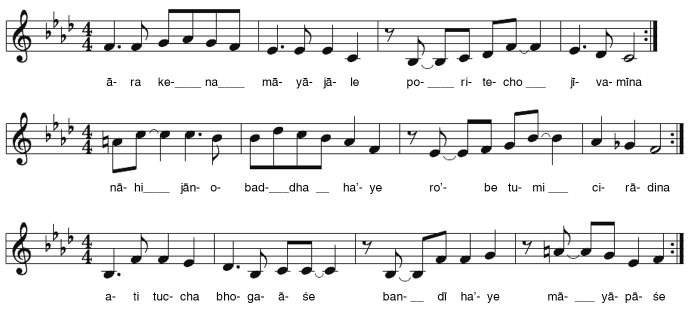
hoinu parama sukhī duḥkha dūre gela, cintā nā rahila, caudike ānanda dekhi ātma-nivedana—surrender; tuyā—your; pade—unto the lotus feet; kari'—offering; hoinu—became; parama—supremely; sukhī—happy; duḥkha—unhappiness; dūre—far away; gela—has gone; cintā—anxiety; nā—not; rahila—remained; caudike—in all directions; ānanda—pleasures derived from them; dekhi—seeing.
I have become supremely happy by surrendering myself at Your lotus feet. Sorrow has gone far away, and there are no more cares. All I see is joy in the four directions.
2 aśoka-abhaya, amṛta-ādhāra,
tomāra caraṇa-dvaya tāhāte ekhana, viśrāma labhiyā chārinu bhavera bhaya aśoka—free from grief; abhaya—free from fear; amṛta-ādhāra—the nectar from His lips; tomāra—Your; caraṇa—lotus feet; dvaya—both; tāhāte—by that; ekhana—now; viśrāma—rest; labhiyā—having attained; chārinu—I have given up; bhavera—of wordly existence; bhaya—fear.
Your two lotus feet are reservoirs of immortal nectar that grant freedom from both sorrow and fear. Resting in them I have found peace, and have completely given up the fear of worldly existence.
3 tomāra saṁsāre, kariba sevana,
nāhiba phalera bhāgī tava sukha jāhe, kariba yatana, ha' ye pade anurāgī tomāra—your; saṁsāre—in the cycle of birth and death; kariba—I shall do; sevana— service; nāhiba—I shall never be; phalera—fruit; bhāgī—enjoyer; tava—your; sukha—happiness; jāhe—of which; kariba-yatana—I shall diligently attend; ha’ ye—having become; pade—Your feet; anurāgī—attached to.
I shall render service in Your household and never endeavor to enjoy the fruits of that service. Rather, I shall strive for whatever pleases You, being fully enamored by Your lotus feet.
4 tomāra sevāya, duḥkha haya yata,
se-o to' parama sukha sevā-sukha-duḥkha, parama sampada, nāśaye avidyā-duḥkha tomāra—Your; sevāya—by service; duḥkha—unhappiness; haya—are; yata— having arisen; se-o—that; to'—indeed; parama—supreme; sukha—happiness; sevā—service; sukha—happiness; duḥkha—unhappiness; parama—supreme sampada—opulences; nāśaye—they destroy; avidyā—nescience; duḥkha— misery.
All the troubles encountered in Your service shall be the cause of great happiness, for in Your devotional service joy and sorrow are equally great riches. Both destroy the misery of ignorance.
5 pūrva itihāsa, bhulinu sakala,
sevā-sukha pe' ye mane āmi to' tomāra, tumi to' āmāra, ki kāja apara dhane pūrva—former; itihāsa—history; bhulinu—I have forgotten; sakala—all; sevā— service; sukha—happiness; pe' ye—having attained; mane—within the mind; āmi—I; to'—indeed; tomāra—Your; tumi—You; to'—indeed; āmāra—My; ki— what; kāja—what is the need for; apara—another; dhane—treasure.
I have completely forgotten all of my past history by feeling in my mind the great joy of Your service. I am indeed Yours, and You are truly mine. What need is there of any other treasure?
6 bhakativinoda, ānande ḍubiyā,
tomāra sevāra tare saba ceṣṭā kare, tava icchā-mata, thākiyā tomāra ghare bhakativinoda—Bhaktivinoda; ānande—in happiness; ḍubiyā—sinking; tomāra— your; sevāra—to serve him; tare—him; saba—all; ceṣṭā—endeavor; kare—makes; tava—Your; icchā—wishes; mato—according to; thākiyā—having stayed; tomāra—Your; ghare—at the home.
Bhaktivinoda sinks deeply into the ocean of pure bliss by engaging in Your service. He devotes all his efforts according to Your wishes while living in Your house.
Commentary
As mentioned earlier, this song is the last of eight songs found in Bhaktivinoda Thakura’s songbook Śaraṇāgati in the section Second Principle of Surrender: Ātma-Nivedana (Dedication of the Self). In Ātma-nivedana Bhaktivinoda Ṭhākura expresses the wonderful result of surrender which leads to unlimited happiness.
Sarvasva tomāra caraṇe
1 sarvasva tomāra, caraṇe saṅpiyā,
parechi tomāra ghare tumi to' ṭhākura, tomāra kukkura, baliyā jānaha more sarvasva—all possessions; tomāra—your; caraṇe—lotus feet; saṅpiyā—having surrendered; parechi—I have fallen; tomāra—your; ghare—in Your own house; tumi—you; to'—indeed; ṭhākura—Lord tomāra—your; kukkura—the dog; baliyā— considering; jānaha— know; more—to me.
Now that I have surrendered all that I possess unto Your lotus feet, I throw myself down before Your house. You are the master of the house; kindly consider me Your own dog.
2 bāṅdhiyā nikaṭe, āmāre pālibe,
rahiba tomāra dvāre pratīpa-janere, āsite nā diba, rākhiba garera pāre bāṅdhiyā—having tethered; nikaṭe—nearby; āmāre—me; pālibe—You will keep; rahiba—I shall stay; tomāra—your; dvāre—at door; pratīpa—adverse; janere— persons; āsite—to come; nā—not; diba—allow; rākhiba—I shall keep; garera—of the moat; pāre—on the other side.
Chaining me nearby, You will maintain me, and I shall lie at Your doorstep. I will not allow Your enemies to enter, but will keep them outside the bounds of the surrounding moat.
3 tava nija-jana, prasāda seviyā,
ucchiṣṭa rākhibe yāhā āmāra bhojana, parama-ānande, prati-dina ha' be tāhā tava—Your; nija—own; jana—of the people; prasād—offered food; seviyā— having honored; ucchiṣṭa—after eating; rākhibe—should allow you to keep; yāhā— as much as; āmāra—my; bhojana—food; parama-ānande—in great happiness; prati—each and every;dina—day; ha' be—there will be; tāhā—that.
Whatever food remnants Your devotees leave behind after honoring Your prasād will be my daily sustenance. I will feast on those remnants in great bliss.
4 basiyā śuiyā, tomāra caraṇa,
cintiba satata āmi nācite nācite, nikaṭe yāiba,
yakhana rākibe tumi
basiyā—sitting down; śuiyā—lay down; tomāra—your; caraṇa—lotus feet; cintiba—I will meditate; satata—always; āmi—I; nācite—while dancing; nācite— while dancing; nikaṭe—near; yāibo—I will go; yakhana—when; rākibe—will call; tumi—You.
While sitting up or lying down, I will constantly meditate on Your lotus feet. Whenever You call, I will immediately run to You and dance in rapture.
5 nijera poṣana, kabhu nā bhāviba,
rahiba bhāvera bhare bhakativinoda, tomāre pālaka, baliyā varaṇa kare nijera—about my own; poṣana—nourishment; kabhu—sometimes; nā—no; bhāviba—I shall think; rahiba—I shall remain; bhāvera—of the sentiments; bhare—absorbed; bhakativinoda—Bhaktivinoda tomāre—You; pālaka— maintainer; baliyā—as; varaṇa—acceptance; kare—do.
I will never think about my own nourishment, and will remain absorbed in ever cherishing love for my master. Bhaktivinoda now accepts You as his only maintainer.
Commentary
This is the third of four songs in Bhaktivinoda Thakura’s songbook Śaraṇāgati, Third Principle of Surrender: Goptṛtve-varaṇa (Acceptance of the Lord as Sole Maintainer). Although we have no recording of Śrīla Prabhupāda singing this song, he referred to it many times, both in his books and his lectures.
Śrīmad-Bhāgavatam 4.29.30-31 – Purport To liken the conditional existence of the living entity to that of a dog is very appropriate. An intelligent human being, however, can understand that if he has to live the life of a dog, he had best become Kṛṣṇa's dog. In the material world a dog is sometimes elevated and is sometimes on the street, but in the spiritual world, Kṛṣṇa's dog is perpetually, eternally happy. Śrīla Bhaktivinoda Ṭhākura has therefore sung: vaiṣṇava ṭhākura tomāra kukkura baliyā jānaha more. In this way Bhaktivinoda Ṭhākura offers to become a Vaiṣṇava's dog. A dog always keeps himself at his master's door and does not allow any person unfavorable to the master to enter. Similarly, one should engage in the service of a Vaiṣṇava and try to please him in every respect. Unless one does so, he does not make spiritual advancement. Śrīmad-Bhāgavatam 7.9.42 – Purport The more one becomes the servant of the servant, the more one becomes perfect in devotional service. This is also the injunction of Bhagavad-gītā: evaṁ paramparā-prāptam imaṁ rājarṣayo viduḥ. One can understand the science of the Supreme Personality of Godhead simply by the paramparā system. In this regard, Śrīla Narottama dāsa Ṭhākura says, tāṅdera caraṇa sevi bhakta-sane vāsa: "Let me serve the lotus feet of the devotees of the Lord, and let me live with devotees." Janame janame haya, ei abhilāṣa. Following Narottama dāsa Ṭhākura, one should aspire to be a servant of the Lord's servant, life after life. Śrīla Bhaktivinoda Ṭhākura also sings, tumi ta' ṭhākura, tomāra kukkura, baliyā jānaha more: "O my Lord, O Vaiṣṇava, please consider me your dog." One must become the dog of a Vaiṣṇava, a pure devotee, for a pure devotee can deliver Kṛṣṇa without difficulty. Kṛṣṇa se tomāra, kṛṣṇa dite pāra. Kṛṣṇa is the property of His pure devotee, and if we take shelter of a pure devotee, he can deliver Kṛṣṇa very easily. Prahlāda wants to engage in the service of a devotee, and therefore he prays to Kṛṣṇa, "My dear Lord, kindly give me the shelter of Your very dear devotee so that I may engage in his service and You may then be pleased." Mad-bhakta-pūjābhyadhikā (SB 11.19.21). The Lord says, "Engaging in the service of My devotee is better than trying to engage in My devotional service." Lecture on Brahmā-saṁhitā - New York, July 19, 1971 If you want to understand Kṛṣṇa, if you want to have Kṛṣṇa, you have to take shelter of Kṛṣṇa's devotee. That is paramparā system. Bhaktivinoda Ṭhākura has sung a very nice song. He's praying to a Vaiṣṇava, vaiṣṇava ṭhākura tomāra kukkura baliyā jānaha more: "Sir, Vaiṣṇava, you are Ṭhākura, you are as good as Kṛṣṇa, or God. Kindly accept me as your dog." Vaiṣṇava ṭhākura tomāra kukkura baliyā jāna... Kukkura means dog. Just like dog follows the master very faithfully. We have to learn something from the dog. The dog also is a teacher: how to become faithful to the master. That teaching we can have even from the dog. He is very satisfied. Whatever food you give, he'll not protest; still, he'll remain faithful. There are so many good qualifications of a dog. So therefore Bhaktivinoda Ṭhākura says, vaiṣṇava ṭhākura tomāra kukkura baliyā jānaha more: "Kindly accept me as your dog. I shall serve you faithfully." Why? Kṛṣṇa se tomāra kṛṣṇa dite pāra: "Because Kṛṣṇa is yours, you can deliver Kṛṣṇa." Very nice song. "Kṛṣṇa is yours. By your devotional service, you have made Kṛṣṇa your property; so you can deliver Kṛṣṇa to me. Therefore I want to follow you as faithfully as a dog." Lecture on Śrīmad-Bhāgavatam 7.9.7 – Mayapur, February 27, 1977 We should always pray, vaiṣṇava ṭhākura, tomāra kukkura baliyā jānaha more. There is a song of Bhaktivinoda Ṭhākura: "My dear Vaiṣṇava Ṭhākura, kindly accept me as your dog." Vaiṣṇava ṭhākura. As the dog, by the indication of the master, does everything very obedient, we have to learn this lesson from the dog, how to become faithful to the master. That is the instruction. In everything you can learn something. Everyone. Therefore mahā-bhāgavata, they accept everyone as guru, to learn something. Actually, from the dog we can learn this art, how to become faithful at the risk of life even. There are many instances, dog have given the life for the master. So we should be a dog of a Vaiṣṇava. Chāriyā vaiṣṇava- sevā, nistāra pāyeche kebā [Someone who avoids serving the devotees of the Lord will never attain perfection in life.]
Tumi sarveśvareśvara
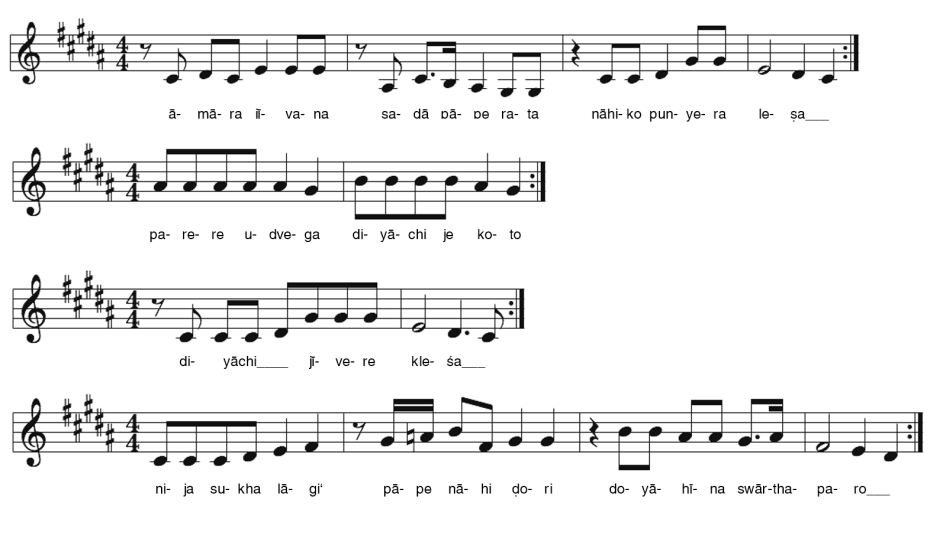
1 tumi sarveśvareśvara, vrajendra-kumāra!
tomāra icchāya viśve sṛjana saṁhāra
tumi—You are; sarveśvareśvara—the Lord of all lords ; vrajendra-kumāra—O youthful son of the king of Vraja; tomāra icchāya—according to Your will; viśve— in the universe; sṛjana—creation; saṁhāra—destruction.
O youthful son of the King of Vraja, You are Lord of all lords. According to Your will, creation and destruction take place in the universe.
2 tava icchā-mata brahmā karena sṛjana
tava icchā-mata viṣnu karena pālana
tava—Your; icchā-mato— according to the desire; brahmā—Lord Brahmā; korena—makes; sṛjana—the creation; tava—Your; icchā-mato—according to the desire; viṣnu—Lord Viṣṇu; korena—performs; pālana—protection and maintenance.
According to Your will Lord Brahmā creates, and according to Your will Lord Viṣnu maintains.
3 tava icchā-mate śiva karena saṁhāra
tava icchā-mate māyā sṛje kārāgāra
tava—Your; icchā-mate— according to the desire; śiva —Lord Śiva; karena— makes; saṁhāra—destruction; tava—Your; icchā-mate—according to the desire; māyā—Māyā; sṛje—constructs; kārāgāra—the prison of this world.
According to Your will Lord Śiva destroys, and according to Your will māyā constructs the prison house of this world.
4 tava icchā-mate jīvera janama-maraṇa samṛddhi-nipāte duḥkha sukha-saṁghaṭana tava—Your; icchā-mato—according to the desire; jīvera—of the soul; janama- maraṇa—there is birth and death; samṛddhi—prosperity; nipāte—poverty; duḥkha—suffering; sukha—happiness; saṁghaṭana—will meet.
According to Your will the living beings take birth and die, and according to Your will they meet with prosperity and ruin, happiness and sorrow.
5 miche māyā-baddha jīva āśā-pāśe phire'
tava icchā vinā kichu karite nā pāre
miche—needlessly; māyā-baddha—bound by maya; jīva—the soul; āśā-pāśe—the fetters of worldly desire; phire'—sanction; tava—Your; icchā—desire; bvnā— without; kichu—anything; karite—to do; nā—not; pāre—is able.
The tiny soul bound up by māyā vainly struggles in the fetters of worldly desire. Without Your sanction the jīva is unable to do anything.
6 tumi to' rākhaka āra pālaka āmāra
tomāra caraṇa vinā āśā nāhi āra
tumi—You are; ta'—certainly; rākhaka—protector; āra—and; pālaka—maintainer; āmāra—my; tomāra—Your; caraṇa—feet; vinā—without; āśā—hope; nāhi—there is no; āra—any other.
You are my only protector and maintainer. Except for Your lotus feet there is no other hope for me.
7 nija-bala-ceṣṭā-prati bharasā chāriyā
tomāra icchāya āchi nirbhara kariyā
nija—own; bala—strength; ceṣṭā—endeavor; prati—every; bharasā—confidence; chāriyā—I have given up; tomāra—Your; icchāya—desire, will; āchi—I am; nirbhara—no burden; kariyā—making.
No longer confident of my own strength and endeavor, I have become solely dependent on Your will.
8 bhakativinoda ati dīna akiñcana tomāra icchāya tā' ra jīvana maraṇa bhakativinoda—Bhaktivinoda; ati—very; dīna—poor; akiñcana—one who does not possess anything in this material world; tomāra—Your; icchāya—desire; tā' ra— according to; jīvana—he will live; maraṇa—he will die.
Bhaktivinoda is most poor, and his pride has been leveled. Now in accordance with Your will he lives and dies.
Commentary
This is the fourth and last song in Bhaktivinoda Thakura’s songbook Śaraṇāgati, Third Principle of Surrender: Goptṛtve-varaṇa (Acceptance of the Lord as Sole Maintainer). To realize that everything – and that means each and every thing – depends on the Lord, is an important step on the path of surrender. A major obstacle to surrender is the false pride of considering ourselves in control and trying to manipulate and exploit the material energy for our own benefit. As long as we rely on our own strength and expertise it is not possible to feel dependend on the mercy of the Lord. Therefore we see sometimes that the Lord deprives a devotee struggling like that of everything so that he may come the point of surrender expressed by Bhaktivinoda Ṭhākura toward the end of the song: “No longer confident of my own strength and endeavor, I have become solely dependent on Your will.”
Ekhana bujhinu prabhu!
1 ekhana bujhinu prabhu! tomāra caraṇa
aśokābhoyāmṛta-pūrna sarva-khana
ekhana—now; bujhinu—I have understood; prabhu!—O Lord; tomāra—your; caraṇa—lotus feet; aśokā—freedom from grief; abhaya—freedom from fear; āmṛta—nectar; pūrna—complete; sarva—of all; khana—moments.
Now I have understood, O Lord, that Your feet are eternally full of sweet nectar that dispels all sorrow and fear.
2 sakala chāriyā tuyā caraṇa-kamale pariyāchi āmi nātha! tava pada-tale sakala—all; chāriyā—giving up; tuyā—your; caraṇa-kamale—lotus feet; pariyāchi—I have fallen; āmi—I; nātha!—o master!; tava—your; pada—feet; tale— beneath.
Surrendering myself and all I possess unto those lotus feet, I have laid myself down submissively under their shelter.
3 tava pāda-padma nātha! rakṣibe āmāre
āra rakṣā-kartā nāhi e bhava-saṁsāre
tava—your; pāda—feet; padma—lotus; nāth!—O master; rakṣibe—who will protect; āmāre—me; āra—other; rakṣā-kartā—proctector; nāhi—there is none; e—these; bhava-saṁsāre—in material existence.
Your lotus feet, O Lord, will certainly shelter me. There are no other protectors in this world of birth and death.
4 āmi tava nitya-dāsa-jāninu e-bāra āmāra pālana-bhāra ekhana tomāra āmi—I; tava—Your; nitya—eternal; dāsa—servant; jāninu—I have understood; e—these; bāra—time; āmāra—my; pālana—protection; bhāra—burden; ekhana— now; tomāra—Your.
At last I know myself to be Your eternal servant. Now the burden of my maintenance is exclusively Yours.
bara duḥkha pāiyāchi svatantra jīvane
duḥkha dūre gela o pada-varaṇe
bara—great; duḥkha—misery; pāiyāchi—I have gotten; svatantra—independent; jīvane—life; duḥkha—misery; dūre—far away; gela—have gone; o—those; pada—feet; varaṇe—by accepting.
In my life of independence from You, I have experienced nothing but misery. But now, upon accepting those feet of Yours, all my miseries have gone far away.
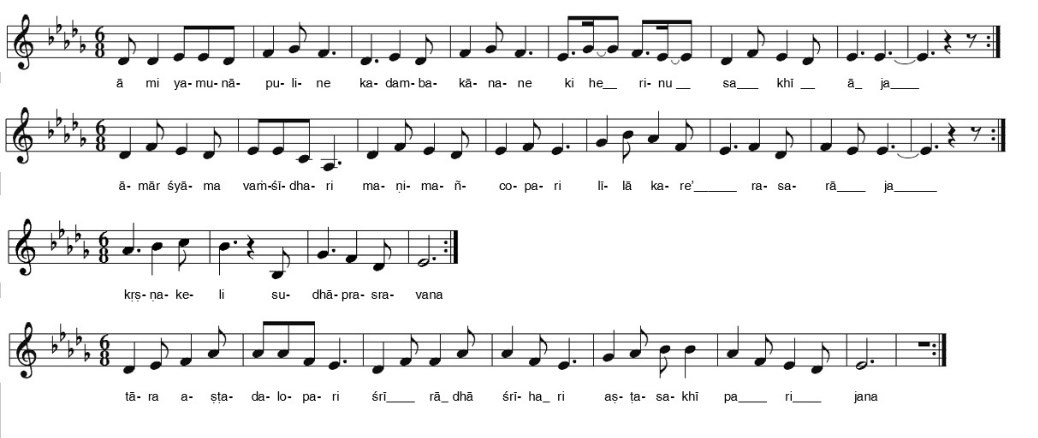
6 ye-pada lāgiyā ramā tapasya karilā
ye-pada pāiyā śiva śivatva labhilā
ye—which; pada—feet; lāgiyā—for the sake; ramā—Ramā devī, the goddess of fortune; tapasya—austerities; karilā—did; ye—which; pada—feet; pāiyā—getting; śiva—Lord Śiva; śivatva—the state of being Śiva and of propitious nature; labhilā— attained.
Desiring a place at Your lotus feet the goddess of fortune performed difficult austerities. Only after receiving Your feet did Lord Śiva attain his śivatva, or quality of auspiciousness.
7 ye-pada labhiyā brahmā kṛtārtha hoilā
ye-pada nārada muni hṛdaye dharilā
ye—which; pada—feet; labhiyā—having attained; brahmā—Lord Brahmā; kṛtārtha—satisfied; hoilā—became; ye—which; pada—feet; nārada—Nārada; muni—Muni; hṛdaye—in the heart; dharilā—held.
Upon obtaining Your feet Lord Brahmā had his desires fulfilled. Your feet are always held by the great sage Nārada Muni within his heart.
8 sei se abhaya pada śirete dhariyā parama-ānande nāci pada-guna gāiyā sei se—those every; abhaya—fearless; pada—feet; śirete—on head; dhariyā— having held; parama-ānande—in great happiness; nāci—I dance; pada—feet; guna—glorious qualities; gāiyā—singing.
I now hold on my head those very same lotus feet, which drive away all fear, while I dance in great ecstasy, singing their glories.
9 saṁsāra-vipada ha' te avaśya uddhāra
bhakativinoda, o-pada karibe tomāra
saṁsāra—in material existence; vipada—dangerous condition of life; ho'te—from; avaśya—certainly; uddhāra—deliver; bhakativinoda—Bhaktivinoda; o—those; pada—feet; karibe—will do; tomāra—Your.
Your lotus feet will surely deliver Bhaktivinoda from the dangerous perils of this worldly journey.
Commentary
This is the first song of four in Bhaktivinoda Thakura’s songbook Śaraṇāgati, Fourth Principle of Surrender: 'Avaśya rakṣibe kṛṣṇa'-viśvāsa, pālana (Faith in Kṛṣṇa as Protector). He describes how everyone, even the greates among demigods, receive the highest benediction by taking shelter under Kṛṣṇa’s lotus feet. On many occasions, Prabhupāda spoke about this topic . Śrīmad-Bhāgavatam 2.6.7 – Purport For absolute protection from all sorts of fear, as well as for all our needs of life, we must take shelter of the lotus feet of the Lord, not only in this planet but also in all the upper, lower and heavenly planets. This absolute dependence on the lotus feet of the Lord is called pure devotional service, and it is directly hinted at within this passage. No one should have any kind of doubt in this matter, nor should one be inclined to seek the help of any other demigods, because all of them are dependent on Him only. Everyone, except the Lord Himself, is dependent on the mercy of the Lord; even the all-pervading Supersoul is also dependent on the supreme aspect of Bhagavān, the Personality of Godhead. Lecture on Bhagavad-gītā 7.5 – Vṛndāvana, August 11 (Janmāṣṭami) 1974 We should seek protection of Kṛṣṇa. This world is so dangerous. It is said, padaṁ padaṁ yad vipadām. Every step there is danger. But if we take shelter, samāśritā ye pada-pallava-plavaṁ mahat-padaṁ puṇya-yaśo murāreḥ, if we take shelter of the lotus feet of Murāri, under whose lotus feet the whole mahat-tattva, cosmic manifestation, is resting, then this big ocean of birth and death, we can cross very easily. Vatsa-padam. Vatsa-padam means the impression by the hoof of a calf and the water contained in it. The whole ocean becomes like a spot, a small spot, created by the impression of the hoof. That is called vatsa-padam. So this Kṛṣṇa consciousness movement is for this purpose. We are requesting and training the bewildered living entities who have forgotten Kṛṣṇa to revive Kṛṣṇa consciousness so that he may be saved from the onslaught of material nature. This is Kṛṣṇa consciousness movement. It is the greatest humanitarian welfare activities to the human society. Take it very seriously and be happy.
Tuwā-bhakti-pratikūla
1 tuwā bhakti-pratikūla dharma yā' te raya
parama yatane tāhā tyajiba niścaya
tuwā—your; bhakti—devotional service; pratikūla—unfavorable; dharma— activities; yā' te raya—remains; parama—supreme; yatane—with care; tāhā—that; tyajiba—I shall give up; niścaya—with great determination.
With great determination and care will I give up all activities which are unfavorable for devotional service.
2 tuyā bhakti-bahir-mukha saṅga nā kariba
gaurāṅga-virodhi-jana-mukha nā heriba
tuyā—your; bhakti—devotional service; bahirmukha—neglecful; saṅga— asociation; nā—not; kariba—I will keep; gaurāṅga—Gaurāṅga; virodhi—averse; jana—of the people; mukha—face; nā—not heriba—I will glance.
I will not keep company with those opposed to devotional service, nor even look at the faces of those inimical toward Gaurāṅga.
3 bhakti-pratikūla sthāne nā kari vasati
bhaktira apriya kārye nāhi kari rati
bhakti—devotion; pratikūla—against; sthāne—in places; nā—not; kari-vasati—I make a residence; bhaktira—of bhakti; apriya—disagreeable; kārye—for work; nāhi—not; kari-rati—I develop attachment.
I will never live at a place unfavorable for devotional practices, and I will never take pleasure in non-devotional activities.
4 bhaktira virodhī grantha pāṭha nā kariba bhaktira virodhī vyākhyā kabhu nā śuniba bhaktira—of devotion; virodhī—antagonistic; grantha—literature; pāṭha—read; nā—no; kariba—I will do; bhaktira—of devotion; virodhī—against; vyākhyā— interpretation; kabhu-nā—never; śuniba—I will hear.
I will not read books opposed to pure devotion, nor listen to any scriptural explanation which goes against the principles of bhakti.
5 gaurāṅga-varjita sthāna tīrtha nāhi māni bhaktira bādhaka jñāna-karma tuccha jāni gaurāṅga—Gaurāṅga; varjita—rejected; sthāna—place; tīrtha—holy place; nāhi— not; māni—I consider; bhaktira—of devotion; bādhaka—obstructive; jñāna— knowledge; karma—action; tuccha—insignificant; jāni—I consider.
I will never regard as sacred any place where Gaurāṅga is rejected. All knowledge or action hindering pure devotional service I consider worthless.
6 bhaktira bādhaka kāle nā kari ādara bhakti bahir-mukha nija-jane jāni para bhaktira—of devotional service; bādhaka—obstructive; kāle—for times; nā—not; kari ādara —I appreciate; bhakti—devotional service; bahirmukha—averse; nija— own; jane—people; jāni—consider; para—strangers.
Any seasonal observance which poses obstacles to the execution of devotional service finds no favor with me, and I consider as strangers all those family members who are averse to devotional service.
7 bhaktira bādhikā spṛhā kariba varjana abhakta-pradatta anna nā kari grahana bhaktira—of devotion; bādhikā—obstruct; spṛhā—desires; kariba varjana—I will give up; abhakta—non-devotees; pradatta—given; anna—food prepared from grains; nā—not; kari grahana—I accept.
I will abandon all desires that obstruct devotional service, and I will never accept food offered to me by non-devotees.
8 yāhā kichu bhakti-pratikūla bali' jāni
tyajiba yatane tāhā, e niścaya vānī
jāhā-kichu—whatever; bhakti—devotional service; pratikūla—unfavorable; bali'— having considered; jāni—I know; tyajiba—I will give up; yatane—diligently; tāhā— that; e—this; niścaya—firm; vānī—words.
I vow to carefully avoid whatever I know to be contrary to devotional service. This is my firm promise.
9 bhakativinoda pari' prabhura caraṇe
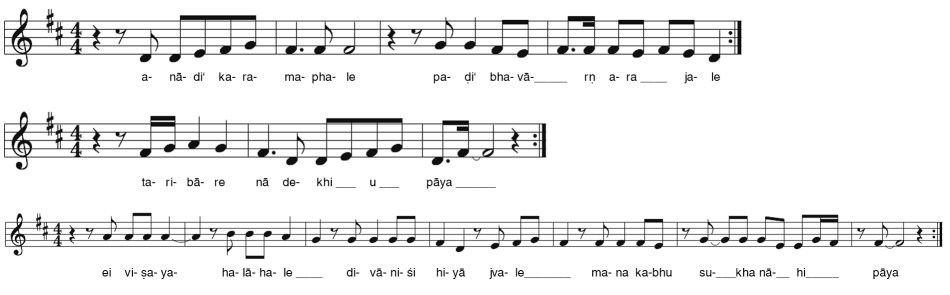
māgaye śakati pratikūlyera varjane
bhakativinoda—Bhakativinoda; pari'—having fallen; prabhura—of the Lord; caraṇe—at the feet; māgaye—begs; śakti—power; pratikūlyera—of all that is unfavorable; varjane—to give up.
Bhaktivinoda falls at the feet of the Lord and begs for the strength to give up all things that are unfavorable to pure devotional service.
Commentary
This is the second song of four in Bhaktivinoda Thakura’s songbook Śaraṇāgati, Fifth Principle of Surrender: Bhakti-Pratikūla-Bhāva Varjanāṅgīkāra (Renunciation of Conduct Unfavorable to Pure Devotion). In this song, Bhaktivinoda Ṭhākura shows the attitude a devotee should have in relation to things unfavorable to devotional service, vowing with determination to give them up. Śrīla Prabhupāda speaks about bhakti-pratikula in his books and lectures. Lecture on Śrīmad-Bhāgavatam 6.2.11 – Allahabad, January 16, 1971 Kaṁsa was also Kṛṣṇa conscious, always thinking of Kṛṣṇa, but that was unfavorably. His business was how to kill Kṛṣṇa. He was thinking of Kṛṣṇa, but his business was he was thinking, "How to kill Kṛṣṇa?" That is prātikūla. Prātikūla is not bhakti. When you think of Kṛṣṇa against His desire, against the principle of satisfying Him, that is not bhakti, although that is also Kṛṣṇa consciousness. An enemy of Kṛṣṇa, he is also thinking of Kṛṣṇa. That does not mean that he is Kṛṣṇa conscious. He is Kṛṣṇa conscious unfavorably. Therefore it is not bhakti. You have to act favorably. Lecture on The Nectar of Devotion – Vṛndāvana, October 31, 1972 As Rāvaṇa and Kaṁsa were thinking of Kṛṣṇa as enemy, similarly, if we think of Kṛṣṇa that "He'll wash my sinful activities," that means we are thinking like Rāvaṇa and Kaṁsa. Kṛṣṇa should be thought favorably. Ānukūlyena kṛṣṇānuśīlanam. Na prātikūlyena. No. You cannot think of Kṛṣṇa and commit sinful life at the same time. That is prātikūla. Kṛṣṇa does not want that you shall remain sinful, because you cannot approach Kṛṣṇa without being free from sinful activities. Yeṣām anta-gataṁ pāpam. Kṛṣṇa is pavitra, paramam. Apāpa-viddham. These are the descriptions. Kṛṣṇa is the Supreme Pure. You cannot approach the Supreme Pure being sinful, and make Kṛṣṇa your order-supplier, that you go on committing sinful life and Kṛṣṇa will wash it. Kṛṣṇa washes it—once, twice, thrice. But if you consciously go on, continue the sinful life, then you'll have to be punished. So we should not think pervertedly, like Rāvaṇa and Kaṁsa. Kaṁsa was always absorbed in thinking of Kṛṣṇa. Also he got salvation. But not as associate, but he merged into the Brahman effulgence.
So these are the points. Ānukūlyena kṛṣṇānuśīlanam. We should execute cultivation of Kṛṣṇa consciousness very favorably, not unfavorably. Favorable means by which Kṛṣṇa becomes pleased, by which your spiritual master becomes pleased. Because when your spiritual master is pleased, Kṛṣṇa is pleased. Yasya prasādād bhagavat-prasādaḥ. The next song explains what is favorable for devotional service.
Śuddha-bhakata
1 śuddha-bhakata-caraṇa-reṇu,
bhajana-anukūla bhakata-sevā, parama-siddhi,
prema-latikāra mūla
śuddha-bhakata—of pure devotees; caraṇa-reṇu—dust from the lotus feet; bhajana-anukūla—is conducive to devotional service; bhakata-sevā—service to the Vaiṣṇavas; parama-siddhi—is the supreme perfection; prema-latikāra mūla— and the root of the creeper of divine love.
The dust from the lotus feet of pure devotees gives rise to devotional service, and service to the devotees is itself the supreme perfection and the root of the tender creeper of divine love.
2 mādhava-tithi, bhakti-jananī,
yetane pālana kari kṛṣṇa-basati, basati bali', parama ādare bari mādhava-tithi—the holy days like Ekādaśī and Janmāṣṭamī; bhakti-jananī—the mother of devotion; yatane pālana kari—I observe with great care; kṛṣṇa-basati— the transcendental abode of Śrī Kṛṣṇa; basati bali'—I choose as my dwelling place; parama ādare bari—with the greatest of reverence and love.
With great care I observe holy days like Ekādaśī and Janmāṣṭamī, for they are the mother of devotion. And with the greatest reverence and love I choose as my dwelling place the transcendental abode of Śrī Kṛṣṇa.
3 gaura āmāra, ye-saba sthāne,
karala bhramaṇa raṅge
se-saba sthāna, heriba āmi,
gaura āmāra—my Lord Gaurasundara; ye-saba sthāne—all the places; karala bhramaṇa—had traveled; raṅge—for pastimes; se-saba sthāna—all those places; heriba āmi—I will behold; praṇayi-bhakata-saṅge—in the company of loving devotees.
In the company of loving devotees I will visit all those places where my Lord Gaurasundara traveled and performed His pastimes.
4 mṛdaṅga-bādya, śunite mana,
abasara sadā yāce gaura-bihita, kīrtana śuni', ānande hṛdaya nāce mṛdaṅga-bādya—the music of the mṛdaṅga drum; śunite—to hear; mana—my mind; abasara—an opportunity; sadā yāce—always begs; gaura-bihita—approved by Lord Gauracandra; kīrtana—the congregational chanting; śuni'—hearing; ānande—in ecstasy; hṛdaya nāce—my heart dances.
My mind always begs to hear the music of the mṛdaṅga, and my heart dances in ecstasy whenever I hear the kind of kīrtana established by Lord Gauracandra.
5 yugala-mūrti, dekhiyā mora,
parama-ānanda haya prasāda-sevā karite haya,
sakala prapañca jaya
yugala-mūrti—the Deity forms of the divine couple; dekhiyā—beholding; mora— my; parama-ānanda haya—supreme bliss comes about; prasāda-sevā karite—to honor the prasādam food remnants; haya—there is; sakala prapañca—all worldly illusions; jaya—I conquer.
I feel supreme bliss when I behold the Deity forms of the divine couple, Śrī Śrī Rādhā and Kṛṣṇa, and I conquer all worldly illusions by honoring the Lord's prasādam.
6 ye-dina gṛhe, bhajana dekhi,
gṛhete goloka bhāya caraṇa-sīdhu, dekhiyā gaṅgā,
sukha nā sīmā pāya
ye-dina—that day; gṛhe—in my house; bhajana dekhi—seeing the worship ceremonies; gṛhete—within the house; goloka bhāya—Goloka Vṛndāvana appears; caraṇa-sīdhu—the river of nectar emanating from the Lord's lotus feet;
dekhiyā gaṅgā—seeing the Ganges river; sukha—my happiness; nā sīmā pāya— knows no bounds.
Every day Goloka Vṛndāvana appears in my home when I see Lord Hari being worshiped there. My joy knows no bounds when I see the Ganges, a river of nectar emanating from the Lord's lotus feet.
7 tulasī dekhi', jurāya prāṇa,
mādhava-toṣaṇī jāni' gaura-priya, śāka-sevane, jīvana sārthaka māni tulasī dekhi'—seeing the holy tulasī tree; jurāya prāṇa—soothes my soul; mādhava- toṣaṇī—she who is pleasing to Lord Mādhava; jāni'—I understand; gaura-priya— dear to Lord Caitanya; śāka-sevane—honoring the spinach preparation; jīvana— life itself; sārthaka māni—I consider successful.
The sight of the tulasī plant soothes my soul, for I know she gives pleasure to Lord Kṛṣṇa. I feel that my life has been fulfilled when I honor śāk, a green leafy vegetable preparation that is a favorite of Lord Caitanya's.
8 bhakativinoda, kṛṣṇa-bhajane,
anakūla pāya yāhā prati-dibase, parama-sukhe,
svīkāra karaye tāhā
bhakativinoda—this Bhaktivinoda; kṛṣṇa-bhajane—for the worship of Lord Kṛṣṇa; anukūla—favorable; pāya yāhā—whatever is obtained; prati-dibase—every day; parama-sukhe—with the greatest of joy; svīkāra karaye—accepts; tāhā—that.
Whatever Bhaktivinoda obtains that furthers devotional service to Śrī Kṛṣṇa he accepts every day with the greatest joy.
Commentary
This is the third song in Bhaktivinoda Thakura’s songbook Śaraṇāgati, Sixth Principle of Surrender: Bhakti-anukūla-mātra kāryera (Acceptance of Activities Favorable to Pure Devotion). Prabhupāda quotes from it in both his books and lectures: Śrī Caitanya-caritāmṛta, Ādi-līlā 7.105 – Purport In this verse the words tomāra prabhāve (“Your influence”) are very important. Unless one is spiritually advanced he cannot influence an audience. Bhaktivinoda
Ṭhākura has sung, śuddha-bhakata-caraṇa-reṇu, bhajana-anukūla. “Unless one associates with a pure devotee, he cannot be influenced to understand devotional service.” These Māyāvādī sannyāsīs were fortunate enough to meet the Supreme Personality of Godhead in the form of a devotee, and certainly they were greatly influenced by the Lord. They knew that since a perfectly advanced spiritualist never says anything false, all his words are reasonable and agree with the Vedic version. A highly realized person never says anything that has no meaning. Māyāvādī philosophers claim to be the Supreme Personality of Godhead, and this has no meaning, but Śrī Caitanya Mahāprabhu never uttered such nonsense. The Māyāvādī sannyāsīs were convinced about His personality, and therefore they wanted to hear the purport of Vedānta philosophy from Him. Śrī Caitanya-caritāmṛta, Antya-līlā 4.211 – Purport Śrīla Bhaktivinoda Ṭhākura writes in a song (Śaraṇāgati 31.3):
gaura āmāra, ye saba sthāne,
karala bhramaṇa raṅge se-saba sthāna, heriba āmi,
“May I visit all the holy places associated with the līlās of Lord Caitanya and His devotees.” A devotee should make a point of visiting all the places where Śrī Caitanya Mahāprabhu performed His pastimes. Indeed, pure devotees of Śrī Caitanya Mahāprabhu even want to see the places He simply visited for only hours or minutes. Lecture – Bombay, September 25, 1973 Bhaktivinoda Ṭhākura, the father of saṅkīrtana movement within two hundred years, he was ācārya and a householder, gṛhastha. He was very responsible officer, magistrate, householder. But he was a great devotee. Not only devotee, but ācārya in the line of Caitanya Mahāprabhu disciplic succession, ācārya. So he sung, ye dine gṛhete bhajana dekhi, gṛhete goloka bhāya: "The day whenever we find there is bhajana," means worshiping the Supreme Lord, "at that time immediately the house becomes Vaikuṇṭha." Actually, that is so. Vaikuṇṭha or Goloka Vṛndāvana is not material things. Just like Kṛṣṇa is not material. Kṛṣṇa... As Kṛṣṇa can stay in His abode, Goloka Vṛndāvana, and still He can stay everywhere... Aṇḍāntara-stha-paramāṇu-cayāntara-stham. That is Kṛṣṇa. Śrī Caitanya-caritāmṛta, Madhya-līlā 7.69 – Purport Although apparently a gṛhastha (householder), Sārvabhauma Bhaṭṭācārya was unlike the so-called karmīs interested in sense gratification. After being initiated by Śrī Caitanya Mahāprabhu, the Bhaṭṭācārya was perfectly situated in the spiritual order; therefore it was quite possible for him to offer blessings even to a sannyāsī. He was always engaged in the service of the Lord, even at home. In our disciplic line we have the example of a perfect householder paramahaṁsa—Śrīla Bhaktivinoda Ṭhākura. In his book Śaraṇāgati, Bhaktivinoda Ṭhākura states, ye- dina gṛhe, bhajana dekhi’, gṛhete goloka bhāya (Śaraṇāgati 31.6). Whenever a householder glorifies the Supreme Lord in his home, his activities are immediately transformed into the activities of Goloka Vṛndāvana, spiritual activities taking place in the Goloka Vṛndāvana planet of Kṛṣṇa. Activities exhibited by Kṛṣṇa Himself at Bhauma Vṛndāvana, the Vṛndāvana-dhāma existing on this planet, are not different from His activities on the planet Goloka Vṛndāvana. This is proper realization of Vṛndāvana anywhere. In our Kṛṣṇa consciousness movement we inaugurated the New Vṛndāvana activities, wherein devotees are always engaged in the transcendental loving service of the Lord, and this is not different from Goloka Vṛndāvana. The conclusion is that one who acts strictly in the line of Śrī Caitanya Mahāprabhu is competent to offer blessings to sannyāsīs, even though he be a gṛhastha householder. Although he is in an exalted position, a sannyāsī still must elevate himself to the transcendental platform by rendering service to the Lord. By His actual behavior, Caitanya Mahāprabhu begged the blessings of Sārvabhauma Bhaṭṭācārya. In this way He set the example of how one should expect blessings from a Vaiṣṇava regardless of his social position. Lecture on Śrīmad-Bhāgavatam 7.6.8 – New Vrindavan, June 24, 1976 So family attachment is the greatest impediment in the matter of advancing in Kṛṣṇa consciousness, but if the whole family is Kṛṣṇa conscious, that is very nice. Just like Bhaktivinoda Ṭhākura, he was a family man, but his wife, his children—and the best child is our Guru Mahārāja, best child... So he has sung by his experience, ye dina gṛhe bhajana dekhi gṛhete goloka bhaya. If family-wise, everyone is engaged in Kṛṣṇa's service, that is very nice. That is not ordinary family. That attachment is not ordinary attachment. But generally people are attached materially. That is condemned here. Śeṣaṁ gṛheṣu saktasya pramattasya apayāti hi. They are called pramatta. Everyone is thinking that "My family, my wife, my children, my nation, my community, that is everything. What is Kṛṣṇa?" This is the greatest illusion imposed by māyā. But nobody will able to give you protection.