 Spiritual
Prayers that express longing for perfection, purification, service and mercy
Ohe! vaiṣṇava ṭhākura 304
Gurudeva! 306
Kabe gaura-vane 307
Śrī-rūpa-mañjarī-pada 309
'Gaurāṅga' balite habe 312
Mama mana mandire 316
Kṛṣṇa deva bhavantam vande 318
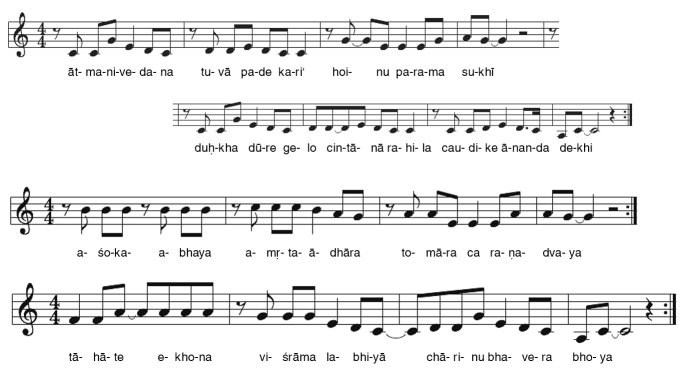
Ohe! vaiṣṇava ṭhākura
1 ohe! vaiṣṇava ṭhākura, dayāra sāgara,
e dāse karuṇā kari' diyā pada-chāyā, śodho he āmāya, tomāra caraṇa dhari ohe! vaiṣṇava ṭhākura–O venerable Vaiṣṇava!; dayāra sāgara–O ocean of mercy!; e dāse–to me, your servant; karuṇā kari'–be merciful; diyā pada-chāyā–giving the shade of your lotus feet; śodho he āmāya–O purify me!; tomāra caraṇa–your feet; dhari–I humbly hold.
O venerable Vaiṣṇava, O ocean of mercy, be merciful unto your servant. Give me the shade of your lotus feet and purify me. I hold on to your lotus feet.
2 chaya vega dami', chaya doṣa śodhi',
chaya guṇa deha' dāse chaya sat-saṅga, deha' he āmāre, baśechi saṅgera āśe chaya vega–the six urges; dami'–controlling; chaya doṣa–the six faults; śodhi'– purifying; chaya guṇa–the six good qualities; deha' dāse–please give to your servant; chaya sat-saṅga–the six kinds of holy association; deha' he āmāre–O give me!; baśechi–I have sat down here; saṅgera–of having your company; āśe–in the hope. Teach me to control my six passions; rectify my six faults, bestow upon me the six qualities, and offer unto me the six kinds of holy association.
3 ekākī āmāra, nāhi pāya bala,
hari-nāma-saṅkīrtane tumi kṛpā kari', śraddhā-bindu diyā, deha kṛṣṇa-nāma-dhane ekakī–alone; āmāra–my; nāhi pāya bala–have no strength; hari-nāma-saṅkīrtane– to chant the holy name of Lord Hari; tumi–you; kṛpā kari'–being merciful; śraddhā- bindu–a particle of faith; diyā–bestowing; deha'–please give; kṛṣṇa-nāma-dhane– the great treasure of the holy name of Kṛṣṇa.
I do not find the strength to carry on alone the saṅkīrtana of the holy name of Hari. Please bless me by giving me just one drop of faith with which to obtain the great treasure of the holy name of Kṛṣṇa.
4 kṛṣṇa se tomāra, kṛṣṇa dite pāra,
tomāra śakati āche āmi to' kāṅgala, 'kṛṣṇa' 'kṛṣṇa' bali', dhāi tava pāche pāche kṛṣṇa se–that Kṛṣṇa; tomāra–is yours; kṛṣṇa dite pāro–you are able to give Kṛṣṇa; tomāra śakati–your power; āche–is; āmi–I; to'–indeed; kāṅgāla–am wretched; ‘kṛṣṇa' ‘kṛṣṇa' bali'–crying Kṛṣṇa! Kṛṣṇa!; dhāi–I run; tava pāche pāche–behind you.
Kṛṣṇa is yours; you have the power to give Him to me. I am simply running behind you shouting, "Kṛṣṇa! Kṛṣṇa!"
Commentary
In his songbook Śaraṇāgati, Bhaktivinoda Ṭhākura elucidates with different songs the six principles of surrender. Then, in two more sections, he describes different kinds of longings (lālasā), namely bhajana-lālasā (longing for divine service), and siddhi-lālasā (longing for spiritual perfection). Ohe! vaiṣṇava ṭhākura is Song 7 and the next one, Gurudeva! is Song 11 in the section Bhajana-lālasā. The following song, Kabe gaura-vane, expresses the longing for spiritual perfection. Śrī Caitanya-caritāmṛta Ādi 11.59 – Purport Śrīla Bhaktivinoda Ṭhākura has sung, kṛṣṇa se tomāra, kṛṣṇa dite pāra, tomāra śakati āche. In this song, Bhaktivinoda Ṭhākura describes that a pure Vaiṣṇava, as the proprietor of Kṛṣṇa and love of Kṛṣṇa, can deliver both to anyone and everyone he likes. Therefore to get Kṛṣṇa and love of Kṛṣṇa one must seek the mercy of pure devotees. Śrīla Viśvanātha Cakravartī Ṭhākura also says, yasya prasādād bhagavat-prasādo yasyāprasādān na gatiḥ kuto ’pi: “By the mercy of the spiritual
master one is blessed by the mercy of Kṛṣṇa. Without the grace of the spiritual master one cannot make any advancement.” By the grace of a Vaiṣṇava or bona fide spiritual master one can get both love of Godhead, Kṛṣṇa, and Kṛṣṇa Himself.
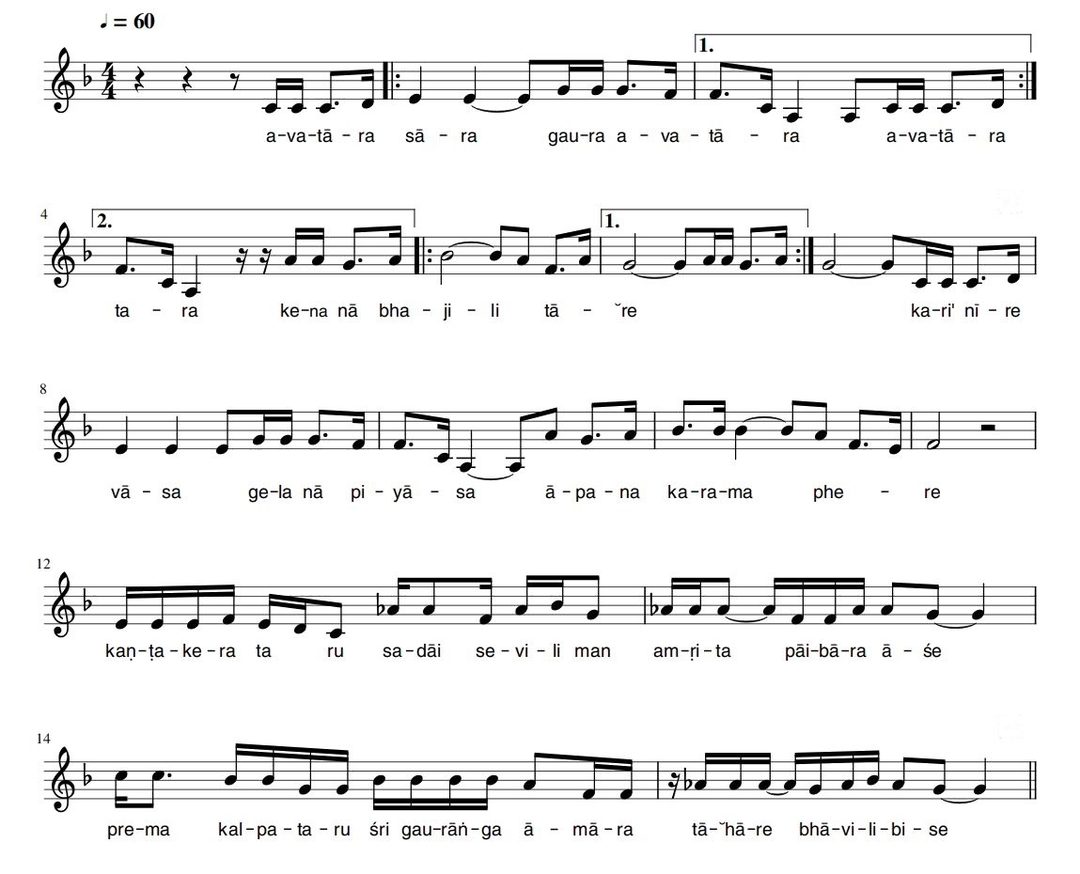
Gurudeva! Bhaktivinoda Ṭhākura
1 gurudeva! kṛpā-bindu diyā, kara' ei dāse,
tṛṇāpekṣā ati hīna sakala sahane, bala diyā kara', nija-māne spṛhā-hīna gurudeva!—O Gurudeva!; kṛpā-bindu—a drop of your mercy; diyā—giving; kara'— make; ei dāse—this servant; tṛṇāpekṣā—than a blade of grass; ati hīna—very humble; sakala sahane—to bear all trials and troubles; bala diyā—giving strength; kara—make; nija-māne—in personal honor; spṛhā-hīna—free from all desires.

O Gurudeva! With a drop of mercy make this servant of yours humbler than a blade of grass. Give me the strength to bear all trials and troubles, and free me from all desire for honor.
2 sakale sammāna karite śakati,
deha' nātha! yathāyatha tabe ta' gāiba, hari-nāma-sukhe, aparādha ha’ be hata sakale sammāna—honoring all living beings; karite—to do; śakati—the power; deha'—please give; nātha!—O Lord!; yathāyatha—befittingly; tabe—then; ta'— certainly; gāiba—I will sing; hari-nāma-sukhe—in the ecstasy of the holy name; aparādha—offenses; ha' be—will become; hata—finished.
O lord and master! Please invest me with the power to honor all living beings properly. Only then will I sing the holy name in great ecstasy, free of offenses.
3 kabe hena kṛpā, labhiyā e jana,
kṛtārtha haibe, nātha! śakti-buddhi-hīna, āmi ati dīna, kara' more ātma-sātha kabe—when?; hena—such; kṛpā—mercy; labhiyā—obtaining; e jana—this devotee; kṛtārtha—fulfilled; hoibe—will become; nātha!—O lord and master!; śakti- buddhi-hīna—devoid of all strength and intelligence; āmi—I; ati dīna—very fallen; kara'—please make; more—me; ātma-sātha—Your beloved servant.
O lord and master! When will such mercy fall to this weak and foolish devotee? Please make me your beloved servant.
4 jogyatā-vicāre, kichu nāhi pāi,
tomāra karuṇā-sāra karuṇā nā haile, kāṅdiyā kāṅdiyā, prāṇa nā rākhiba āra jogyatā-vicāre—in examining my worth; kichu nāhi—absolutely nothing; pāi—I find; tomāra—Your; karuṇā sāra—mercy is essential; karuṇā nā haile—if You are not merciful; kāṅdiyā kāṅdiyā—weeping constantly; prāṇa—life; nā rākhiba—I will not maintain; āra—any longer.
When I examine myself, I find nothing of value. Therefore your mercy is essential to me. If you are not merciful, I shall simply weep and weep, and I shall not maintain my life.
Commentary
This is Song 11 in Bhaktivinoda Ṭhākura’s songbook Śaraṇāgati where the author elucidates the six principles of surrender. Thereafter, he describes two types of longings: bhajana-lālasā (longing for divine service), and siddhi-lālasā (longing for spiritual perfection). The following song, Kabe gaura-vane, expresses the longing for spiritual perfection.
Kabe gaura-vane
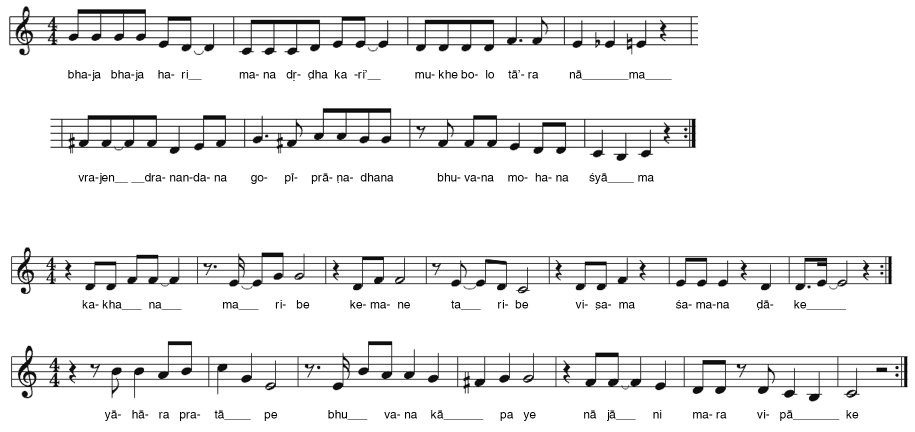
1 kabe gaura-vane, suradhunī-taṭe,
‘ha rādhe ha kṛṣṇa’ bale’ kāṅdiyā berā’ba, deha-sukha chari’, nana-latā taru-tale kabe–when?; gaura-vane–in the forest of Lord Gaurāṅga (Navadvīpa); suradhunī- taṭe–on the banks of the celestial Ganges; ‘ha rādhe ha kṛṣṇa' bole'–chanting, “O Rādhā! O Kṛṣṇa!”; kāndiyā–while weeping; berā'ba–I will wander; deha-sukha chāri'–forgetting all physical comforts; nānā latā-taru–of various creepers and trees; tale–under the shade.
When, oh when will I wander here and there weeping in the shade of the trees and creepers along the banks of the celestial Ganges River in Navadvipa? I will cry out "Oh Radhe! Oh Krsna!", and will completely forget about all the so-called pleasures of the material body.
2 śva-paca-gṛhete, māgiyā khāibo,
pibo sarasvatī-jala puline puline, garā gari diba, kari' kṛṣṇa-kolāhala śva-paca-gṛhete–at the homes of the dog-eaters; māgiyā–by begging; khāibo–I will take my meals; pibo–I will drink; sarasvatī-jala–the water of the Sarasvatī river; puline puline–along both the banks of the river; garā-gari diba–I will roll on the ground; kari' kṛṣṇa-kolāhala–shouting loudly “Kṛṣṇa! Kṛṣṇa!”.
When will I be able to live so simply by begging some food from the homes of the untouchables? I will drink the water of the Sarasvatī river, and in ecstasy I will roll about on the banks of the river, shouting in a loud voice "Krsna! Krsna!".
3 dhāma-vāsī jane, praṇati kariyā,
māgibo kṛpāra leśa vaiṣṇava-caraṇa-renu gāya mākhi', dhari' avadhūta-veśa dhāma-vāsī jane–to the inhabitants of the holy land; praṇati koriyā–bowing down; māgibo–I will beg; kṛpāra leśa–a bit of their mercy; vaiṣṇava-caraṇa-renu–the dust of the Vaiṣṇavas' feet; gāya mākhi'–smearing on my body; dhari'–I will wear; avadhūta-veśa–the dress of a mendicant.
When will I bow down to all the inhabitants of the holy land of Navadvipa and humbly beg for a drop of their mercy? I will smear the dust of the Vaisnavas' lotus feet all over my body, and will wander around wearing the dress of a madman.
4 gaura-vraja-jane, bheda nā dekhiba,
hoibo varaja-vāsī dhāmera svarūpa, sphuribe nayane, hoibo rādhāra dāsī gauḍa-braja-jane–the inhabitants of Navadvīpa and those of Vraja-bhūmi; bheda nā dekhiba–I will see no difference; haiba–I will be transformed; varaja-vāsī–into a resident of Vraja; dhāmera svarūpa–the true nature of the Lord's abode; sphuribe nayane–will manifest itself to my eyes; haiba–and I will become; rādhāra dāsī–a maidservant of Śrīmatī Rādhārāṇī.
When will I make no distinction between the holy land of Gaura-mandala and Vraja-mandala? At that time, I shall be transformed into a resident of Vraja. Then I will see the true form of the transcendental realm opening up before my very eyes, and I will thus become one of the maidservants of Śrīmatī Rādhārāṇī.
Commentary
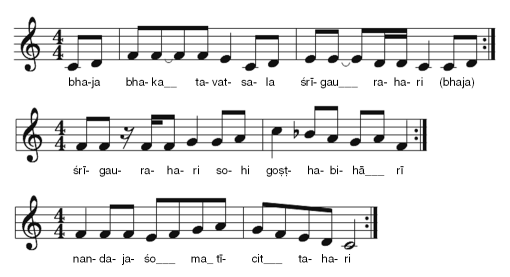
The original title being Siddhi-lālasā, this song expresses a longing for perfection. Like some other songs by Bhaktivinoda Ṭhākura, it begins with the word kabe, when? Gaura-kiśora dāsa Bābājī said in reference to this song: “Those who take up the dress of a bābājī often say they will take to madhukārī. Madhukārī is a transcendental practice. Those who adopt this occupation surrender themselves to Kṛṣṇa, their bodily consciousness being vanquished. On the other hand, the materialists who have a taste for gratifying their tongues and genitals are bound in the cycle of birth and death for a long time. Those who want to chant and worship in Vraja or Navadvīpa, but are dependent for their maintenance on materialists, are like cows kept under protection. Those who collect their alms by begging from door to door in the name of madhukārī for eating well are pious bulls. The real principle of madhukārī has been well stated in a song composed by Bhaktivinoda Prabhu: kabe gaura-vane, suradhunī-taṭe …” In the second verse, this principle is expressed to the extreme. Bhaktivinoda Ṭhākura asks himself when he will be able to live in such a simple way that he does not mind accepting food from the homes of people who eat dog flesh. Just the thought in itself is repulsive, yet the ācārya hankers for such a vision that sees all inhabitants of the holy land of Navadvīpa as eternal associates of Lord Gaurāṅga. We are not advised to imitate such behavior, but songs like Siddhi-lālasā remind us of the lofty ideals of true Vaiṣṇava character.
Śrī-rūpa-mañjarī-pada
1 śrī-rūpa-mañjarī-pada, sei mora sampada,
sei mora bhajana-pūjana sei mora prāṇa-dhana, sei mora ābharaṇa, sei mora jīvanera jīvana śrī-rūpa-mañjarī-pada—the feet of Śrī Rūpa Mañjarī; sei—they; mora sampada— are my real wealth; sei mora bhajana-pūjana—they are the object of my service and worship; sei mora prāṇa-dhana—they are the treasure of my heart; sei mora ābharaṇa—they are my ornaments; sei mora jīvanera jīvana—and they are the life of my life.
The lotus feet of Śrī Rūpa Mañjarī are my real wealth. They are the object of my devotional service and worship. They are the treasure of my heart, and they are my ornaments and the life of my life.
2 sei mora rasa-nidhi, sei mora vāñchā-siddhi,
sei mora vedera dharama sei vrata, sei tapa, sei mora mantra-japa, sei mora dharama-karama sei mora rasa-nidhi—they are the reservoirs of all transcendental mellows for me; sei mora vāñchā-siddhi—they are the fulfillment of all my desires.; sei mora vedera dharama—they are the conclusion of the religion of the Vedas for me; sei vrata— they are the goal of all my vows; sei tapa—and austerities; sei mora mantra-japa— and the chanting of my personal mantra; sei mor dharama-karama—they are the purpose of all my religious activities.
For me they are the reservoirs of all rasa and the conclusion of the religion of the Vedas. They are the fulfillment of all my desires and the goal of all my vows, my austerities, my religious activities, and the chanting of my mantra.
3 anukūla habe vidhi, se-pade haibe siddhi,
nirakhiba e dui nayane se rūpa-mādhurī-rāśi, prāṇa-kuvalaya-śaśi, praphullita habe niśi-dine anukūla habe—will become favorable to devotion; vidhi—all my activities; se- pade—by the power of those feet; haibe siddhi—spiritual perfection will be achieved; nirakhiba—I will be able to actually see; e dui nayane—with these two eyes; se rūpa-mādhurī-rāśi—the waves of sweet beauty flowing from Śrī Rūpa Mañjarī's feet; prāṇa-kuvalaya—upon the lotus of my heart; śaśī—shining like the brilliant moon; praphullita habe—will blossom; niśi-dine—both night and day.
By the power of those lotus feet my activities will become favorable to devotion, I will achieve spiritual perfection, and with these two eyes I shall be able to actually see. Both day and night the flood of exquisite beauty of Śrī Rūpa Mañjarī’s divine lotus feet will shine like the brilliant full moon upon the lotus of my heart, soothing my afflicted soul.
4 tuwā adarśana-ahi, garale jārala dehī,
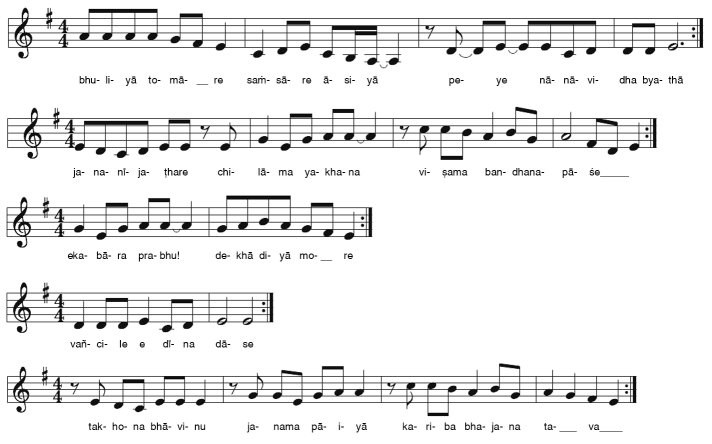
cira-dina tāpita jīvana
hā hā rūpa kara dayā, deha more pada-chāyā,
narottama laila śaraṇa
tuwā adarśana-ahi—the snake of separation from you; garale—by the venom; jārala—has wasted away; dehī—my body; cira-dina—perpetually; tāpita jīvana— my life is afflicted with a great fever; hā hā rūpa—alas! alas! O Rūpa Mañjarī!; kara dayā—please be merciful; deha more—give to me; pada-chāyā—the shade of your lotus feet; narottama—Narottama dāsa; laila śaraṇa—has taken refuge.
O Rūpa Mañjarī, the venom of the snake of separation from you has enfeebled my soul, and now my life is ever afflicted and distressed. Alas! Please have mercy and give me the shade of your lotus feet. Narottama dāsa has taken refuge.
Commentary
This is Song 16, entitled Lālasā (Longings), in Narottama dāsa Ṭhākura’s songbook Prārthana. It is the first of a series of songs expressing the desire to become a follower of Rūpa Gosvāmī in the spiritual world where he serves Rādhā and Kṛṣṇa in his spiritual form of Rūpa Mañjarī. In the Śrī Caitanya-caritāmṛta (Madhya 8.246), Prabhupāda writes: “Of all the gopīs, Śrīmatī Rādhārāṇī is the topmost. Rūpa Gosvāmī and Sanātana Gosvāmī are the most exalted servitors of Śrīmatī Rādhārāṇī and Lord Śrī Caitanya Mahāprabhu. Those who adhere to their service are known as rūpānuga devotees. In a lecture on Śrīmad-Bhāgavatam 5.5.2, given on April 13, 1975, in Hyderabad, Prabhupāda says:
śrī-caitanya-mano 'bhīṣṭaṁ
sthāpitaṁ yena bhū-tale svayaṁ rūpaḥ kadā mahyaṁ
dadāti sva-padāntikam
We Gauḍīya Vaiṣṇava, we are known as rūpānuga. Rūpānuga means the followers of Rūpa Gosvāmī. So why we should become followers of Rūpa Gosvāmī? Because śrī-caitanya-mano 'bhīṣṭaṁ sthāpitaṁ yena bhū-tale: he wanted to establish the mission of Śrī Caitanya Mahāprabhu. … Kṛṣṇa wanted that people should take shelter of His lotus feet, sarva-dharmān parityajya. But people misunderstood Him. Therefore Kṛṣṇa came as a devotee, Śrī Caitanya Mahāprabhu. Rūpa Gosvāmī could understand that; therefore he offered his first prayer to Śrī Caitanya Mahāprabhu, namo mahā vadānyāya kṛṣṇa-prema-pradāya te. “Śrī Caitanya Mahāprabhu, You are the most munificent incarnation because You are not only giving the knowledge of Kṛṣṇa, but You are giving the process how to love Him,” kṛṣṇa-prema-pradāya te.”
In Śrīla Bhaktisiddhānta Sarasvatī Ṭhākura’s biography it is mentioned that Śrī- rūpa-mañjarī-pada was one of his favorite songs, and he requested it to be sung at the time of his leaving this world.
'Gaurāṅga' balite habe
1 'gaurāṅga' balite habe pulaka-śarīra
'hari hari' balite nayane ba' be nīra
‘gaurāṅga’ balite—while chanting the holy name of Lord Gaurāṅga; habe—will it be?; pulaka-śarīra—shivering bodily limbs; ‘hari hari' balite—while chanting the holy name of Lord Hari; nayane—from my eyes; ba'be nīra—tears will fall.
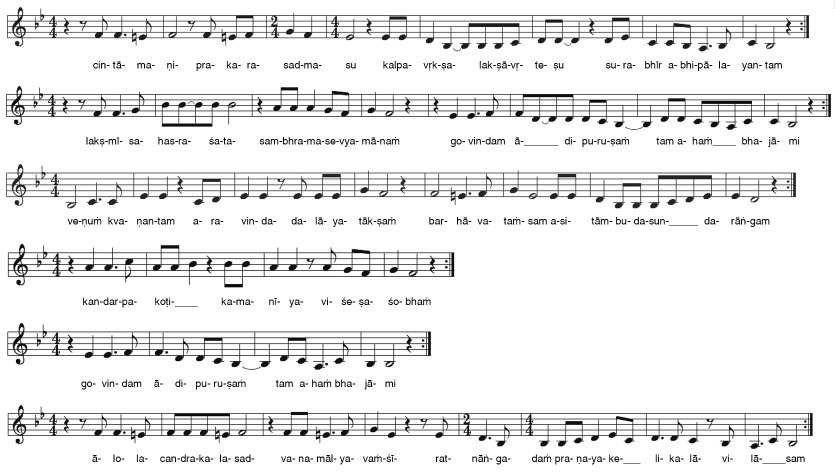
When will that opportune moment come to me when there will be shivering of the body as soon as I chant Lord Gaurāṅga's name? And after the shivering, while chanting Hare Kṛṣṇa, when will there be tears pouring down from my eyes?.
2 āra kabe nitāi-cāṅdera karuṇā haibe saṁsāra-vāsanā mora kabe tuccha ha’ be āra kabe—and when?; nitāi-cāṅdera—of the moonlike Lord Nityānanda karuṇā— mercy; haibe—will be shown to me; saṁsāra-vasanā mora—my worldly desires; kabe—when?; tuccha—insignificant; ha’ be—will become.
When will that day come when the moonlike Nityānanda will bestow His causeless mercy upon me so that my desire for material enjoyment becomes insignificant?
3 viṣaya chāriyā kabe śuddha ha’ be mana
kabe hāma heraba śrī-vṛndāvana
viṣaya chāriyā—giving up sense gratification; kabe—when?; śuddha ha' be—will become completely purified; mana—my mind; kabe—when?; hāma heraba—I will behold; śrī-vṛndāvana—the transcendental realm of Śrī Vṛndāvana.
When my mind is completely purified, being freed from material anxieties and desires, then I shall be able to understand Vṛndāvana and the conjugal love of Rādha and Kṛṣṇa, and then my spiritual life will be successful.
4 rūpa-raghunātha-pade haibe ākuti kabe hāma bujhaba se yugala-pīriti rūpa-raghunātha-pade—for the feet of Śrīla Rūpa and Raghunātha dāsa Gosvāmīs; hoibe ākuti—will be eager; kabe—when?; hāma bujhaba—I will understand; se—that; yugala-pīriti—the conjugal loving affairs of the divine couple.
When shall I be very much eager to study the books left by the six Gosvāmīs? One has to learn of the conjugal loving affairs of Rādhā-Kṛṣṇa through the teachings of these six Gosvamīs.
5 rūpa-raghunātha-pade rahu mora āśa prārthanā karaye sadā narottama-dāsa rūpa-raghunātha-pade—at the feet of Śrīla Rūpa and Raghunātha dāsa Gosvāmīs; rahu—may it remain; mora āśa—my hope; prārthanā karaye—offering prayers; sadā—always; narottama-dāsa—Narottama dāsa.
Narottama dāsa always wishes to understand this conjugal love under the direction of the six Gosvāmīs.
Commentary
This is Song 1 in Narottama dāsa Ṭhākura’s Prārthana. The official title is Lālasā- mayi (Longing for direct service of the Lord). Śrīla Prabhupāda quotes quite often from 'Gaurāṅga' balite habe, both in his books and lectures. Here are some examples. Śrī Caitanya-caritāmṛta Ādi-līlā 7.17 – Purport By attachment to the devotional service of Lord Caitanya Mahāprabhu one immediately comes to the ecstatic position. When he develops his love for Nityānanda Prabhu he is freed from all attachment to the material world, and at that time he becomes eligible to understand the Lord's pastimes in Vṛndāvana. In that condition, when one develops his love for the six Gosvāmīs, he can understand the conjugal love between Rādhā and Kṛṣṇa. These are the different stages of a pure devotee's promotion to conjugal love in the service of Rādhā and Kṛṣṇa in an intimate relationship with Śrī Caitanya Mahāprabhu. Śrī Caitanya-caritāmṛta Ādi-līlā 8.31 – Purport One should first take shelter of Gaura-Nityānanda in order to reach, ultimately, Rādhā-Kṛṣṇa. Śrīla Narottama dāsa Ṭhākura sings in this connection:
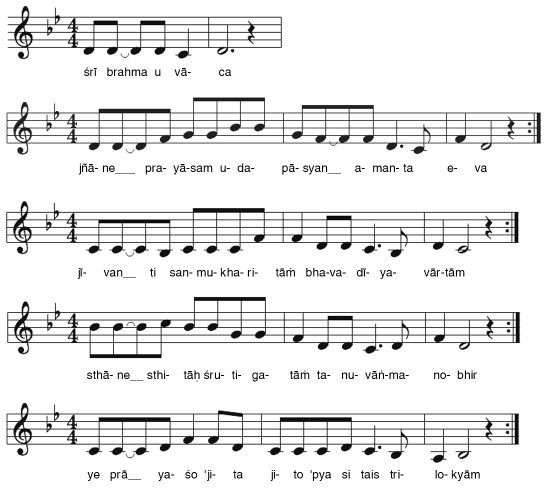
gaurāṅga balite ha’be pulaka śarīra
hari hari balite nayane ba’be nīra āra kabe nitāi-cāṅdera karuṇā karibe saṁsāra-vāsanā mora kabe tuccha habe viṣaya chāriyā kabe śuddha habe mana kabe hāma heraba śrī-vṛndāvana
In the beginning one should very regularly chant Śrī Gaurasundara’s holy name and then chant the holy name of Lord Nityānanda. Thus one’s heart will be cleansed of impure desires for material enjoyment. Then one can approach Vṛndāvana- dhāma to worship Lord Kṛṣṇa. Unless one is favored by Lord Caitanya and Nityānanda, there is no need to go to Vṛndāvana, for unless one’s mind is purified, he cannot see Vṛndāvana, even if he goes there. Actually going to Vṛndāvana involves taking shelter of the six Gosvāmīs by reading the Bhakti-rasāmṛta-sindhu, Vidagdha-mādhava, Lalita-mādhava and the other books that they have given. In this way one can understand the transcendental loving affairs between Rādhā and Kṛṣṇa. Kabe hāma bujhaba se yugala-pirīti. The conjugal love between Rādhā and Kṛṣṇa is not an ordinary human affair; it is fully transcendental. In order to understand Rādhā and Kṛṣṇa, worship Them and engage in Their loving service, one must be guided by Śrī Caitanya Mahāprabhu, Nityānanda Prabhu and the six Gosvāmīs, Lord Caitanya’s direct disciples.
For an ordinary man, worship of Śrī Caitanya and Nityānanda Prabhu or the Pañca- tattva is easier than worship of Rādhā and Kṛṣṇa. Unless one is very fortunate, he should not be induced to worship Rādhā-Kṛṣṇa directly. A neophyte student who is not sufficiently educated or enlightened should not indulge in the worship of Śrī Rādhā and Kṛṣṇa or the chanting of the Hare Kṛṣṇa mantra. Even if he does so, he cannot get the desired result. One should therefore chant the names of Nitāi-Gaura and worship Them without false prestige. Since everyone within this material world is more or less influenced by sinful activities, in the beginning it is essential that one take to the worship of Guru-Gaurāṅga and ask their favor, for thus despite all his disqualifications one will very soon become qualified to worship the Rādhā-Kṛṣṇa vigraha.
It should be noted in this connection that the holy names of Lord Kṛṣṇa and Gaurasundara are both identical with the Supreme Personality of Godhead. Therefore one should not consider one name to be more potent than the other. Considering the position of the people of this age, however, the chanting of Śrī Caitanya Mahāprabhu’s name is more essential than the chanting of the Hare Kṛṣṇa mahā-mantra because Śrī Caitanya Mahāprabhu is the most magnanimous incarnation and His mercy is very easily achieved. Therefore one must first take shelter of Śrī Caitanya Mahāprabhu by chanting śrī-kṛṣṇa-caitanya prabhu- nityānanda śrī-advaita gadādhara śrīvāsādi-gaura-bhakta-vṛnda. By serving Gaura-Nityānanda one is freed from the entanglements of material existence and thus becomes qualified to worship the Rādhā-Kṛṣṇa Deity.
Lecture on Śrī Caitanya-caritāmṛta, Ādi-līlā 7.149 – San Francisco, March 18, 1967 There is a very nice song sung by one poet, Vaiṣṇava poet. He's singing like this: gaurāṅga balite habe pulaka-śarīra hari hari balite nayane ba'be nīra. He's aspiring that "When I shall loudly call 'Lord Caitanya, Gaurāṅga'?" Gaurāṅga is Lord
Caitanya. "And my body will be shivering. And when I shall chant Hare Kṛṣṇa, tears will flow down from my eyes." Āra kabe nitāi-cānder karuṇā hoibe: "And when I shall be favored by Nityānanda Prabhu?" Saṁsāra-bāsanā mora kabe tuccha ha'be: "When I shall be detached from material enjoyment?" Viṣaya chāriyā kabe śuddha ha'be mana: "And when I shall be detached from this material enjoyment, my mind will be purified. My mind will be freed from all contamination of material dirty things." Kabe hāma herabo śrī-vṛndāvana: "And at that time it will be possible to see Vṛndāvana." Rūpa-raghunātha-pade hoibe ākuti. Now, here the singer says that "When I shall be fully devoted to the principles of Rūpa Gosvāmī so that I'll be able to understand what is the pastimes of Rādhā and Kṛṣṇa?" In other words, if we want to understand Rādhā and Kṛṣṇa and Caitanya philosophy, then we should try to follow the instruction left by Rūpa Gosvāmī and Sanātana Gosvāmī. They are the commanders-in-chief of this movement.
Lecture on Śrīmad-Bhāgavatam 1.5.31 – Vṛndāvana, August 12, 1974 But the best thing is as Narottama dāsa Ṭhākura says, that viṣaya chāṛiyā kabe śuddha ha'be mana kabe hāma herabo śrī-vṛndābana. Viṣaya chāṛiyā. As long as I have got the propensity for sense gratification there is no possibility for understanding Vṛndāvana. There is no possibility. It is the statement of Narottama dāsa Ṭhākura. He says viṣaya chāṛiyā kabe śuddha. Viṣaya means this āhāra- nidrā-bhaya-maithunam. If you are still inclined for eating, sleeping and sex life, there is no possibility of understanding what is Vṛndāvana. So these are the instructions. These are the confidential message given by Śrī Caitanya Mahāprabhu and His followers. That is yena. If you follow this yena gacchanti tat-padam, then you are sure going back to home, back to Godhead, Kṛṣṇa. And that is the highest perfection of life.
Śrī Caitanya-caritāmṛta Madhya-līlā 25.271 – Purport The essence of spiritual knowledge is found in the pastimes of Śrī Caitanya Mahāprabhu, which are identical with the pastimes of Lord Kṛṣṇa. This is the essence of knowledge. If knowledge does not include the understanding of Śrī Caitanya Mahāprabhu and Kṛṣṇa, it is simply superfluous. By Śrī Caitanya Mahāprabhu's grace, the nectar of Lord Śrī Kṛṣṇa's pastimes is flowing in different directions in hundreds and thousands of rivers. One should not think that the pastimes of Śrī Caitanya Mahāprabhu are different from Kṛṣṇa's pastimes. It is said: śrī-kṛṣṇa-caitanya, rādhā-kṛṣṇa nahe anya. Lord Caitanya Mahāprabhu is a combination of Rādhā-Kṛṣṇa, and without understanding His pastimes, one cannot understand Rādhā and Kṛṣṇa. Śrīla Narottama dāsa Ṭhākura therefore sings: rūpa- raghunātha-pade hoibe ākuti kabe hāma bujhaba se yugala pirīti. "When shall I become very eager to study the books left by the six Gosvāmīs? Then I shall be able to understand the conjugal pastimes of Rādhā and Kṛṣṇa." Caitanya
Mahāprabhu directly empowered Śrīla Rūpa Gosvāmī and Śrīla Sanātana Gosvāmī. Following in their footsteps, the other six Gosvāmīs understood Śrī Caitanya Mahāprabhu and His mission. One should understand Śrī Kṛṣṇa Caitanya and Lord Śrī Kṛṣṇa from the Gosvāmīs in the paramparā system. This Kṛṣṇa consciousness movement is following as strictly as possible in the footsteps of the Gosvāmīs. Narottama dāsa Ṭhākura says, ei chaya gosāi yāra, mui tāra dāsa: "I am the servant of the six Gosvāmīs." The philosophy of Kṛṣṇa consciousness is to become the servant of the servant of the servant of the Lord. Whoever wants to understand the difficult subject matter of kṛṣṇa-kathā should accept the disciplic succession. If one is somehow or other able to understand Kṛṣṇa, his life will be successful. Tyaktvā dehaṁ punar janma naiti mām eti so 'rjuna. A perfect devotee is able to understand Kṛṣṇa through the disciplic succession, and his entrance into the kingdom of God is thereby certainly opened. When one understands Kṛṣṇa, there is no difficulty in transferring oneself to the spiritual kingdom.
Mama mana mandire
(refrain) mama mana mandire raha niśi-dina
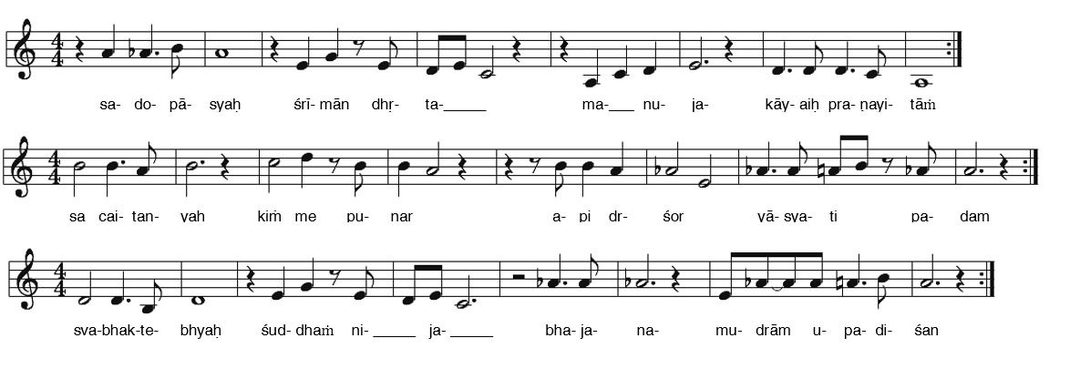
mama mana—my mind; mandire—in the temple; raha—please stay; niśi-dina— night and day; kṛṣṇa murāri śrī kṛṣṇa murāri.
Please reside in the temple of my heart both day and night, O Kṛṣṇa Murāri, O Śrī Kṛṣṇa Murāri!
1 bhakti prīti mālā candana tumi nio he nio cita-nandana bhakti—devotion; prīti—affection; mālā—flower garland; candana—sandalwood; tumi—You; nio—please accept; he—O!; nio—please accept; cita-nandana—O delighter of the heart!
Devotion, love, flower garlands, and sandalwood-please accept, O please accept them, delighter of the heart!
2 jīvana maraṇa tava pūjā nivedana
sundara he mana-hārī
jīvana maraṇa—in life or death; tava pūjā—Your worship; nivedana—prayers; sundara—O beautiful one!; he—O!; mana-hārī—O thief of the mind!
In life or in death I worship You with these offerings, o beautiful one, O enchanter of the heart!
3 eso nanda-kumāra āra nanda-kumāra
habe prema-pradīpe ārati tomāra
eso—please come; nanda-kumāra—O son of Nanda!; āra—furthermore; nanda- kumāra—O son of Nanda!; habe—there will be; prema-pradīpe—with the lamp of love; ārati tomāra—Your worship ceremony.
Come, son of Nanda, and then O son of Nanda I will offer Your ārati ceremony with the lamplight of my love.
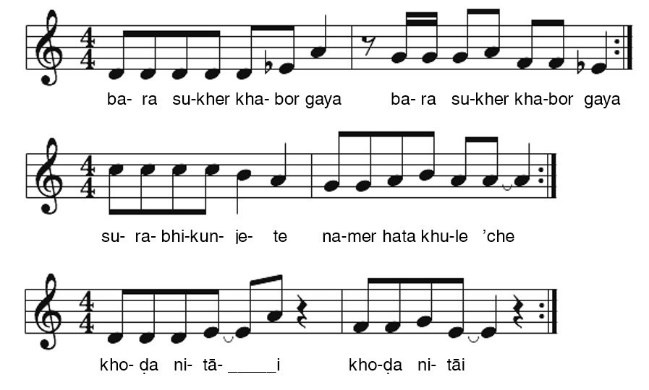
4 nayana yamunā jhare anibāra
tomāra virahe giridhārī
nayana—my eyes; yamunā—the river Yamunā; jhare—flows; anibāra— incessantly; tomāra virahe—in Your separation; giridhārī—O lifter of Govardhana Hill!
The waters of the Yamunā river cascade incessantly from my eyes in Your separation, O holder of Govardhana Hill!
5 vandana gāne tava bajuka jīvana
vandana gāne—in songs of praise; tava—Your; bajuka jīvana—may I pass my life; kṛṣṇa murāri śrī kṛṣṇa murāri.
May I pass my life absorbed only in songs of Your praise, O Krishna Murāri, Śrī Kṛṣṇa Murāri!
Commentary
Bhaktivinoda Ṭhākura expresses in this song a longing for the Lord’s constant presence in his heart and the subsequent opportunity to offer Him service. Śrīla Prabhupāda points out in the purport to Śrīmad-Bhāgavatam 1.9.47: “The devotees of the Lord are always in the heart of the Lord, and the Lord is always in the hearts of the devotees. That is the sweet relation between the Lord and His devotees. Due to unalloyed love and devotion for the Lord, the devotees always see Him within themselves, and the Lord also, although He has nothing to do and nothing to aspire to, is always busy attending to the welfare of His devotees.” Śrīla Bhaktisiddhānta Sarasvatī Ṭhākura said in this regard: “Pure devotees install the Lord in the temple of their hearts and then constantly serve Him there with love. The devotees headed by Prahlāda Mahārāja have also served the Lord by
establishing Him in a temple in their hearts. It is not possible to keep a temple open at all times, but the heart temple never closes.” (Amṛta-vāṇī 13).
Kṛṣṇa deva! bhavantam vande
Rūpa Gosvāmī
(Refrain) kṛṣṇa deva! bhavantaṁ vande man-mānasa-madhukaram arpaya nija-pada-paṅkaja-makarande kṛṣṇa—O Kṛṣṇa!; deva—O Lord!; bhavantam—to You; vande—I offer my respectful obeisances; mat—my; mānasa-madhukaram—bee-like mind; arpaya— please offer; nija—Your own; pada-paṅkaja—of Your lotus feet; makarande—in the nectar.

O Lord Kṛṣṇa! I offer my respectful obeisances unto You. Please fix my bee- like mind in the nectar of Your lotus feet.
1 yady api samādhiṣu vidhir api paśyati
na tava nakhāgra-marīcim idam icchāmi niśamya tavācyuta tad api kṛpādbhuta-vīcim yadi api—although; samādhiṣu—in his trance; vidhiḥ api—even Lord Brahmā; paśyati—sees; na—not; tava—Your; nakha-agra—tips of the toenails; marīcim— rays of effulgence; idam—this very thing; icchāmi—I desire; niśamya—I have heard; tava—Your; acyuta—O Acyuta!; tat api—still; kṛpā-adbhuta-vīcim— wonderful waves of Your mercy.
O Acyuta! Although the great Lord Brahmā, in his trance of samādhi, is unable to see even a particle of the effulgence emanating from the tips of the nails of Your lotus feet, still I desire this vision, for I have heard of the wonderful waves of Your mercy.
2 bhaktir udañcati yady api mādhava
na tvayi mama tila-mātrī parameśvaratā tad api tavādhika durghaṭa-ghaṭana-vidhātrī bhaktir—devotion; udañcati—arises; yadi api—although; mādhava—O Mādhava; na—not; tvayi—for You; mama—my; tila-mātrī—seseme seed; parameśvaratā— the Supreme Lord; tad api—still; tavādhika—; durghaṭa—impossible; ghaṭana— possible; vidhātrī—who may bring about.
O Mādhava! Although my devotion for You does not even equal a sesame seed, because You are the Supreme Lord above all, You can make the impossible possible.
3 ayam avilolatayādya sanātana
kalitādbhuta-rasa-bhāram nivasatu nityam ihāmṛta nindati vindan madhurima-sāram ayam—this; avilolatayā—with fixed steadiness; adya—today; sanātana—O eternal Lord!; kalita—experiencing; adbhuta-rasa—wonderful mellows; bhāram— full; nivasatu—may it reside; nityam—eternally; iha—here; amṛta—nectar of the gods; nindati—defeats; vindan—enjoying; madhurima-sāram—the essence of sweetness. O Sanātana! Your lotus feet surpass even the nectar of the gods. Finding in this lotus flower of Your feet the essence of sweetness which is endowed with truly wonderful mellows, I pray that today the bee of my mind may eternally reside there.
Commentary
This another of the few songs written in Sanskrit. Prabhupāda speaks about this song in the 1. Canto of Śrīmad-Bhāgavatam (11.26): The pure devotees are always hankering after the lotus feet of the Lord. The lotus has a kind of honey which is transcendentally relished by the devotees. They are like the bees who are always after the honey. Śrīla Rūpa Gosvāmī, the great devotee ācārya of the Gauḍīya-Vaiṣṇava-sampradāya, has sung a song about this lotus honey, comparing himself to the bee: "O my Lord Kṛṣṇa, I beg to offer my prayers unto You. My mind is like the bee, and it is after some honey. Kindly, therefore, give my bee-mind a place at Your lotus feet, which are the resources for all transcendental honey. I know that even big demigods like Brahmā do not see the rays of the nails of Your lotus feet, even though they are engaged in deep meditation for years together. Still, O infallible one, my ambition is such, for You are very merciful to your surrendered devotees. O Mādhava, I know also that I have no genuine devotion for the service of Your lotus feet, but because Your Lordship is inconceivably powerful, You can do what is impossible to be done. Your lotus feet can deride even the nectar of the heavenly kingdom, and therefore I am very much attracted by them. O supreme eternal, please, therefore, let my mind be fixed at Your lotus feet so that eternally I may be able to relish the taste of Your transcendental service." The devotees are satisfied with being placed at the lotus feet of the Lord and have no ambition to see His all-beautiful face or aspire for the protection of the strong arms of the Lord. They are humble by nature, and the Lord is always leaning towards such humble devotees.