 Spiritual
In the early 2000s, the devotees of Rupa Goshala bought a cow on the outskirts of Madrid. They named her Yamuna, in honor of the river that flows through Vrindavan, where Krishna and His friends performed many pastimes. The name suited her perfectly, as her fondness for water would soon reveal itself on more than one occasion.
When the devotees went to collect Yamuna with the temple van, she refused to get in, and it took them nearly four hours before they finally managed to load her. Shortly after, Yamuna gave a strong headbutt and broke one of the side windows. The glass hung loose, and the cow stuck her head out. That is how they crossed all of Madrid—with Yamuna’s head poking out the window.
Later, as they were leaving the city, Yamuna struck again with her horn, this time breaking the rear window. So, for the rest of the journey, Yamuna alternated between sticking her head out of the rear window and the side one. That is how she arrived at New Vrajamandala—looking all around through the windows.
«When she arrived at the farm, Yamuna was two years old and about three months pregnant. At the end of her pregnancy, she gave birth to Gopi. It was a very complicated delivery. I remember that December 23rd perfectly. I was returning from India and knew that Yamuna was giving birth, so I went to see her immediately. When I arrived, Gopi had already been born, and Yamuna had what appeared to be the placenta hanging down.
At that time, I was quite inexperienced and did not really understand what was happening. A devotee told me, “That must be the placenta. It will come off during the day, and then she’ll eat it herself.” The placenta is very nutritious and helps strengthen the milk for the calf’s first days.
However, the next day the supposed placenta was still there. So we quickly called the veterinarian, who arrived right away at the goshala. There we discovered that it was not the placenta, but the uterus, which had completely inverted. It is like when you turn a sock inside out. We had to reinsert it as quickly as possible, since Yamuna’s life was in danger.
We spent about four hours in total massaging the cow and pushing the uterus back in. We lifted it with a sheet up to the height of the vulva and, with oil and massages, gradually reintroduced it. When one of us got tired, another took over; when the second was exhausted, a third stepped in. In this way, four of us worked for several hours.
Once it was back in place, the veterinarian made some stitches on the vulva to prevent the uterus from coming out again. Yamuna had to be anesthetized, but only lightly, as she needed to remain standing; that way, at least, she would not feel so much pain.
It was December 24th, 9:00 p.m., when the veterinarian said, “Thank God, we’ve saved her life.”» —Anadi
Yamuna recovered well and raised Gopi without any problems. At New Vrajamandala, the calves are not separated from their mothers—they can drink as much milk as they wish. Naturally, however, when they begin to eat grass, their milk intake decreases. Thus, by six months, Gopi started eating more grass and drinking less from her mother. Even so, Yamuna continued producing plenty of milk, so there was more and more to be milked each day.
Vacation on an Island
One day, in the middle of winter, Yamuna had gone to the other side of the river, to a small island. There she was, enjoying her “vacation,” as if she were on a little beach—very calm, eating the greenest grass.
“What are you doing over there, Yamuna?” asked Alberto.
Determined to bring her back, he crossed the river using some fallen trees that served as a bridge. Once there, he tried to help her return to the goshala, but she flatly refused. She did not want to move. No matter how much he insisted, Yamuna stood her ground firmly. Alberto waited a while and tried again. She walked a little, but as soon as she reached the edge of the river, she suddenly stopped, as if her legs had sunk into the earth. Perhaps she sensed that the river’s current had strengthened—or maybe she simply did not feel like returning. The fact was, there was no way to make her move forward.
Alberto, together with his friend Antonio, decided to build her a more accessible path so she could cross more easily, but Yamuna was not interested in that either. She made no effort to come back.
During one of the attempts to get her across, Yamuna moved a little but stumbled and fell into the water. She lay there, and since she was already an older cow, she found it hard to get up. Her head became submerged, and the cowherds, reacting immediately, rushed to grab her by the horns to lift her head so she could breathe. But in the middle of the struggle, Yamuna made a sudden movement, raising her neck so forcefully that Alberto was thrown backward. The impact sent him straight into the water, soaking him from head to toe—in the middle of winter.
Despite that incident and the freezing cold he had to endure, Alberto did not give up on his effort to bring Yamuna back. Moved by her situation, he began visiting her regularly. He brought her fruit and vegetables, stroked and petted her to make her feel more comfortable, and even went there to milk her. Perhaps, he thought, that way he could convince her to come home.
Each time he went to see or milk her, he had to cross the river using the fallen trees, which required extra effort. Yet, despite all his dedication, Yamuna would not yield. The situation was becoming increasingly concerning.
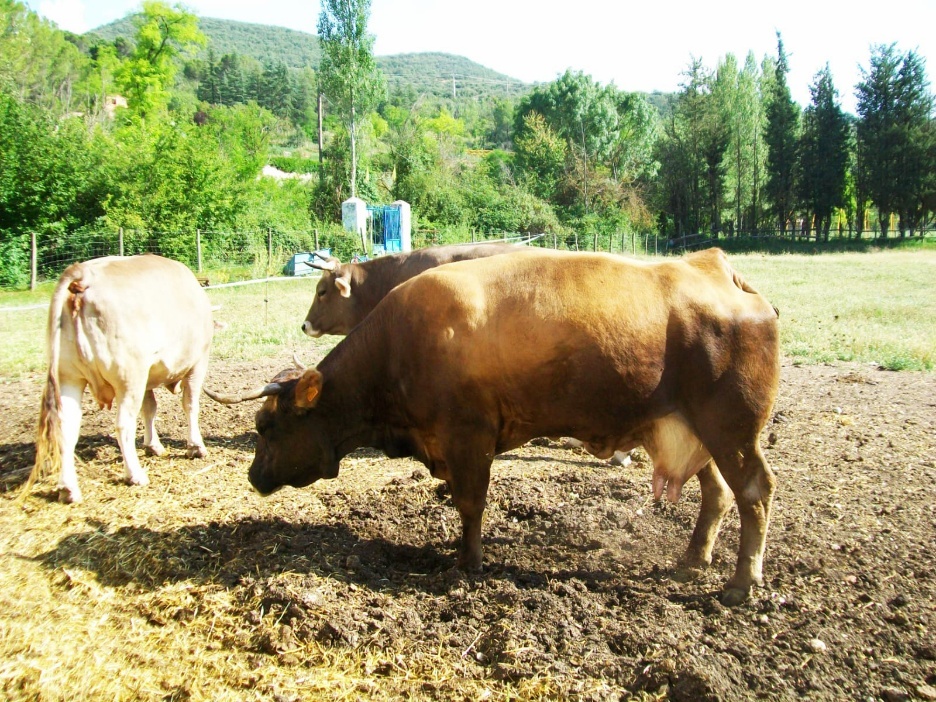 So Alberto decided to consult Venudhara, one of the oldest residents of New Vrajamandala, who had once been one of the most experienced cowherds. After Alberto told him what had happened, Venudhara firmly said:
Yamuna
“Do not give her food. Do not give her anything at all.”
“What do you mean, do not give her food? Poor thing…”
“Not poor thing. Do not give her food.”
Following his advice, Alberto stopped bringing food to Yamuna. He only offered her a small handful of feed when he went to milk her—just enough to wet her mouth and let her lick a little. Nothing more.
On the third day, Yamuna appeared on her own at the barn door. She had understood that if she wanted to eat, she had to come back.
***
Having an unfenced river near the dairy farm always presented a risk for the cows. Although the water rarely exceeds half a meter in depth in its usual course, when it floods, it can reach more than a meter and
a half, becoming dangerous. Not only did Yamuna have problems trying to cross it; on another occasion, Tilaka also got trapped. Although the water is not always deep, the current and the uneven terrain make it difficult for them to get out on their own.
These incidents made clear the need to take preventive measures to protect the animals and avoid future complications. For this reason, today Rupa Goshala now has protective fence along the entire field that borders the river.
Yamuna was a happy cow: she enjoyed the company of her daughter and, later, her grandson Rupa throughout her life. She lived a very peaceful life and, since giving birth to Gopi, she gave milk for fourteen years. During her time at the dairy farm, she demonstrated her weakness for water, falling into the canal twice and crossing the river twice. On one of those occasions, she was left on the other side of the river for a week; they had to bring her food, milk her, and carve out a path for her, with a pickaxe and shovel, so she could return more easily. And one of the times she fell into the canal, the devotees threw stones for more than three hours so that the depth would gradually decrease, and Yamuna could get out.
The Farewell
Yamuna stopped giving milk a month before she passed away, as her fondness for water led her into a difficult situation that would eventually cause her death.
The cold was intense when Yamuna left her body. She was already very old, and walking had become hard for her because of her hip. The fields behind the goshala were filled with frozen puddles, and
she fell into one of them. The surface broke under her weight, trapping her in the water.
The devotees tried to help her with ropes, but it was impossible to free her. Since they could not pull her out, they decided at least to drag her from the puddle and move her to a place with dry grass. They managed to do so, but once there, she could no longer stand—she could not lift herself up or stay on her feet.
Night was quickly approaching, bringing with it the intense cold that would freeze everything, including Yamuna. They had to act urgently. Unable to move her in time and with night already falling, the devotees looked for alternatives. They decided to light bonfires around Yamuna to keep her warm and help her survive the night. They lit five fires and kept them burning all night, taking turns every two hours to watch over them and make sure Yamuna did not freeze.
The next day, Yamuna was still alive, though still unable to get up. They had to find a way to bring her to the goshala, where she would be more protected, under a roof and on warm straw. Then Krishna inspired them with an idea: to use a large old iron door. They tied the door to the van and brought it to where Yamuna lay. Taking her legs, they pulled firmly toward the door. Yamuna rolled over her rounded back and was resting on the door within seconds.
Once she was on the door, they slowly dragged her with the van to the goshala. There they made her comfortable and cared for her.
Death was gradually approaching, and after a month of care, her time was drawing near. It was a difficult period, as lying down for so long caused sores, so they had to turn her over and massage her constantly with ointments.
Finally, the day of her departure came. Alberto covered Yamuna with a blanket, and they carried her body to the goshala door. Gopi, who was far away, sensed what had happened and ran toward her mother’s lifeless body. She laid her head upon her, mooed loudly three times, and then slowly walked away toward the field.