 Spiritual
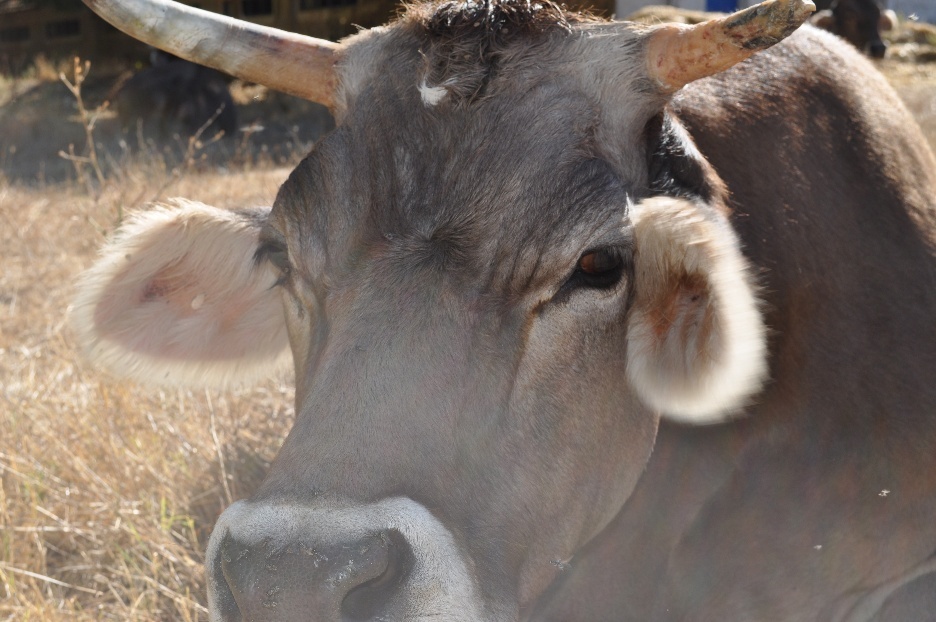
Tilaka was a very special cow. A business man from the Indian community had offered to donate a cow, and together with Alberto he went to a dairy farm near Madrid. The owner showed them three beautiful cows, all pregnant and about to give birth. He told them to choose which one they wanted to take. The decision was not difficult, because one of them had a small white mark on her forehead, resembling a symbol of Vishnu. Just like the Vaishnavas, that cow bore a tilaka mark, and so, without hesitation, they chose her out of the three and named her Tilaka.
A few weeks later, Tilaka gave birth to a beautiful calf, who was named Dhira. It soon became clear that she had inherited many of her mother’s qualities—especially her kindness and patience—and although she never had offspring of her own, she became an adoptive mother and gave milk until her final days. Dhira’s story will be told later.
Over time, Tilaka became an extraordinary cow—very mellow, with infinite patience—so that hundreds of people, mostly children, had the privilege of milking her.
This was how the cowherd shared many stories, and the children enjoyed them immensely. The children—and also the adults—because deep down, we never really stop being children. Perhaps we might wonder: why did Alberto devote so much time to the children? He himself explains:
 “Because look, it is very simple… What you do as a child stays with you for life. When we’re adults, we cannot even remember what we ate yesterday. But the experiences we live as children, when we’re like a sponge, we absorb them, and they stay with us forever. So, these memories that the children will have of their childhood in the goshala will last a lifetime. And just think what mercy I’ve had to be able to do this.”
In this regard, the children who shared their childhood with the cows are now teenagers, and some already adults. Time has passed, and without a doubt, the cowherd’s mission has been fulfilled.
“I have many memories from my childhood that are happy and meaningful to me. I remember when we called the cows with ‘bolo, bolo, bolo,’ and they came; when we were milking and Alberto poured milk into my hand and I drank it; and when we offered the flowers we picked outside. I remember the stories he told us in the hay barn and how we used to play there.
When we fed the kittens milk from a bowl. I remember the Cow Festival, when I played the drums and the mayor came.
I remember when Gopi was leaving her body, and we were all there chanting the holy name, accompanying her until she left…
I also remember Tilaka, because she was my favorite cow: she was always calm and did not move while we were milkcing her. It is incredible that the cows on the farm produced so muh milk, every day, for so many years. That is not normal. I’m grateful that Alberto always received me with kindness and affection at the goshala, teaching me to get to know the cows and to milk them. That is a big part of my childhood, and those are beautiful and important memories for me.” —Gauranga
“What I liked most about the goshala was when I milked the cows and when Alberto called them and they all came. Also when we walked among them, when we went to pick flowers for the altar, and many other things.” —Gayatri
“I’m one of the girls who grew up on the New Vrajamandala farm. I have beautiful and special memories of the goshala because it was where I spent my early childhood years. My friends and I would go to milk the cows, and we were all there together. While one of us was milking, another would brush a cow or pet her, or we’d simply stay there together, waiting eagerly for our turn to sit on the little stool with the milk bucket. It was very special; we enjoyed it so much. When we finished milking, Alberto would take us to the hay barn and tell us stories. We had such a good time. I remember running in and climbing like crazy onto the hay piles, sitting down to listen to him, and then staying to play afterwards. That was my childhood—my happy early years.”. —Kunti
“I have many memories of the goshala. I still have my two friends, Gauranga and Kunti, and we often recall the stories in the hay piles. We used to climb up there; I was terrified to do it, but I did it anyway because they did. I remember seeing the little cows, the river, the caravan; I remember the stories Alberto told us, like the one about Tulasi’s pacifier, which is still there. I’ll always keep a beautiful memory of that goshala and all the goodness it gave me, with great affection. When we arrived, we always had to bring a little flower to offer, and we’d all make the offering together: one lit the incense, another rang the bell, another placed the flower.
And the milking… I do not remember the cows’ names very well, but I do remember milking, being so small, looking at the huge cow and milking her. It was amazing. When the cows came to drink water and stuck their heads through the fence… their heads were enormous and covered us with slobber. It was so beautiful… I remember it with great 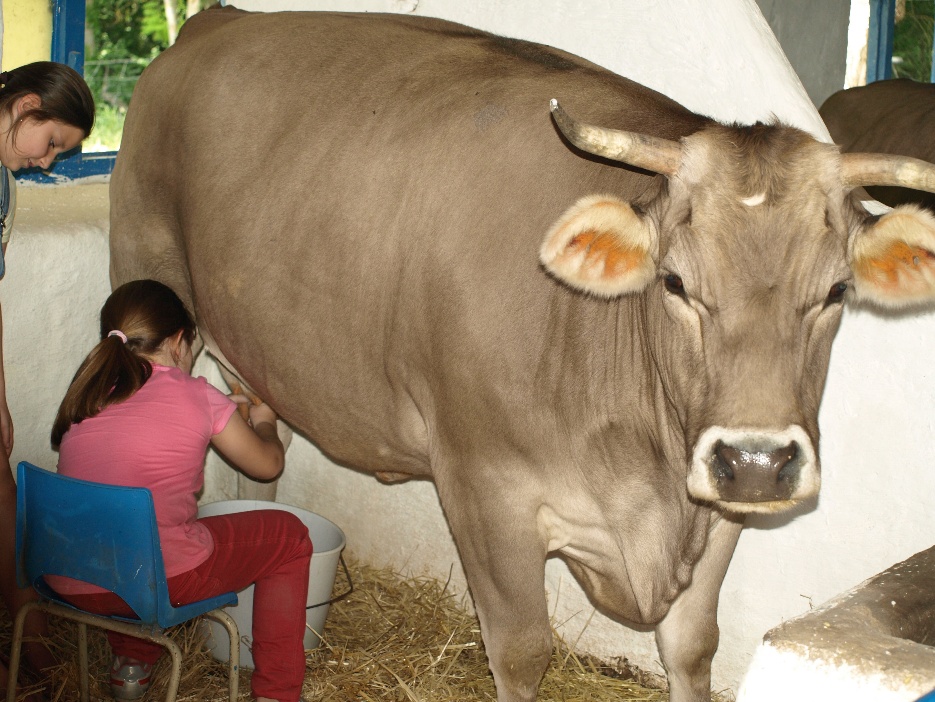 fondness.” —Ishani
Ishani milking Tilaka
“There are so many memories. When I walked toward the goshala, I felt a beautiful connection with Krishna through the cowherd, through his service, and through the great and beloved devotees of the Lord—the cows. I loved when we called them; they already recognized the sound of the call and came happily to eat. I was fascinated to feed them, to feel that I, as a child, almost a teenager, was being nourished myself. It lit something inside me, like a spark; I felt a surge of love and affection just by feeding the cows. It was a special connection.
Another memory is when we brushed them—seeing their faces of satisfaction, how they enjoyed being caressed. As a child, you see things differently. At that moment, I felt that when I brushed them, they looked at me with a special affection just because I was caring for them. That is, without realizing it, spiritual merit being accumulated, which helps one remain conscious of Krishna in this life. Being able to chant my japa, follow the principles, do service, and help in preaching—I believe, to a great extent, comes from serving the cows of New Vrajamandala. I’m very grateful to them.
And coming from the city, arriving in the countryside and seeing the cows… As a child, I felt like I was producing milk. I did not really understand much—an adult can grasp it—but at that moment, I touched the udders, squeezed, and milk came out. To me, it was mystical, a connection that went beyond words. I cannot exactly express what I felt; I can say love, affection, tenderness… but they were many sensations at once. And when I think back, I tell myself, ‘When I have children, I’ll have them milk cows,’ because if they can feel the same, it is something wonderful.” —Arjuna (boy)
The Rescue of Tilaka
No one knows how Tilaka ended up on the other side of the river, but she refused to cross the water and come back. Alberto, who was there alone and had no rope at hand, took off his belt and used it to tie her horns. The problem was that as he did so, his pants started to fall down, so he had to hold them up with one hand while gently pulling the cow with the other to make her walk.
As you may remember, Tilaka was a very good-natured, calm, and obedient cow, so she followed him without resistance. However, to reach a bridge and cross back, they had to walk nearly two kilometers. The most difficult part was that on the way back they had to walk almost a kilometer alongside the road, which was dangerous. Alberto needed to hold Tilaka somehow, and at that moment, the only thing he had was his belt. Fortunately, it was enough, and he managed to bring her safely back to the goshala.
The journey was not quick. One kilometer there and one back took them nearly two hours, because they did not just walk—they also stopped to let Tilaka eat fresh grass, take in the view, and rest for a while. Despite the challenges, the effort was worthwhile, and once again, patience and affection brought home one of Rupa Goshala’s most beloved cows.